Selecting hardwood flooring for a busy commercial space is harder than it looks. You need something that handles constant footfall, survives Glasgow’s damp climate, and still looks sharp enough to impress clients on day one. The wrong choice means costly repairs, business disruption, and a floor that ages poorly under pressure. This article breaks down the most practical hardwood options for Glasgow businesses, weighing up durability, aesthetics, and real-world maintenance demands so you can make a confident, informed decision.
Key Takeaways
| Point | Details |
|---|---|
| Durability is crucial | Choose engineered or solid hardwood for the best balance of strength and longevity in commercial spaces. |
| Climate compatibility matters | Engineered boards are best for Glasgow as they resist moisture and warping. |
| Aesthetics count | Patterns like herringbone or specific wood species enhance your brand’s style. |
| Professional advice pays off | Consulting experts prevents costly mistakes and ensures the right installation for your needs. |
Key criteria for choosing commercial hardwood floors
Before you compare wood species or finishes, you need to be clear on what your business actually requires from a floor. Not every hardwood performs the same way under commercial conditions, and cutting corners on the wrong criteria is one of the most expensive mistakes you can make.
Here are the key factors to weigh up:
- Durability and hardness: High-footfall environments need boards rated highly on the Janka hardness scale. Oak and ash are popular because they resist denting and surface wear over years of use.
- Moisture resistance: Moisture resistance and strength are critical for Glasgow’s climate. Boards that swell or warp from humidity can become a liability.
- Aesthetic alignment: Your floor is part of your brand. Warm tones, cool greys, or natural finishes all send different messages to customers and staff.
- Maintenance demands: Oiled finishes need periodic reapplication. Lacquered boards are easier to clean but harder to spot-repair.
- Budget versus lifespan: A cheaper floor replaced every seven years costs more than a quality floor lasting twenty-plus years. Always calculate lifecycle cost, not just upfront price.
To avoid flooring errors that derail projects, plan your specification before sourcing materials.
Pro Tip: For office or hospitality spaces, consider acoustic properties. Hardwood can amplify noise, so underlays or engineered boards with acoustic backing reduce echo noticeably in open-plan areas.
With the criteria clear, we’ll now explore the leading hardwood options suitable for business environments.
Engineered hardwood: Stability and style
Engineered hardwood is built from a real wood veneer bonded over multiple layers of high-density board or plywood. That cross-layered construction is what makes it so stable. Unlike a solid plank, engineered boards do not expand and contract dramatically with changes in temperature or humidity, which matters enormously in Scottish commercial buildings where heating systems cycle throughout the day.
Key advantages for business use:
- Moisture resistance: Engineered hardwood offers superior moisture resistance and is ideal for commercial use, particularly in entrance areas or kitchens where humidity fluctuates.
- Underfloor heating compatibility: Engineered boards work well over radiant heating systems, which are increasingly common in modern commercial fit-outs.
- Wide species and finish choice: You can achieve the look of walnut, oak, or smoked ash without the vulnerabilities of a full solid plank.
- Simpler maintenance: A quality sealant keeps boards looking clean and makes spills easy to manage in retail or hospitality settings.
- Faster installation: Many engineered products use click-lock systems, reducing installation time and business downtime.
Pro Tip: Choose a wear layer of at least 4mm for commercial settings. Thicker wear layers allow sanding and refinishing if surface damage occurs, extending the floor’s working life considerably.
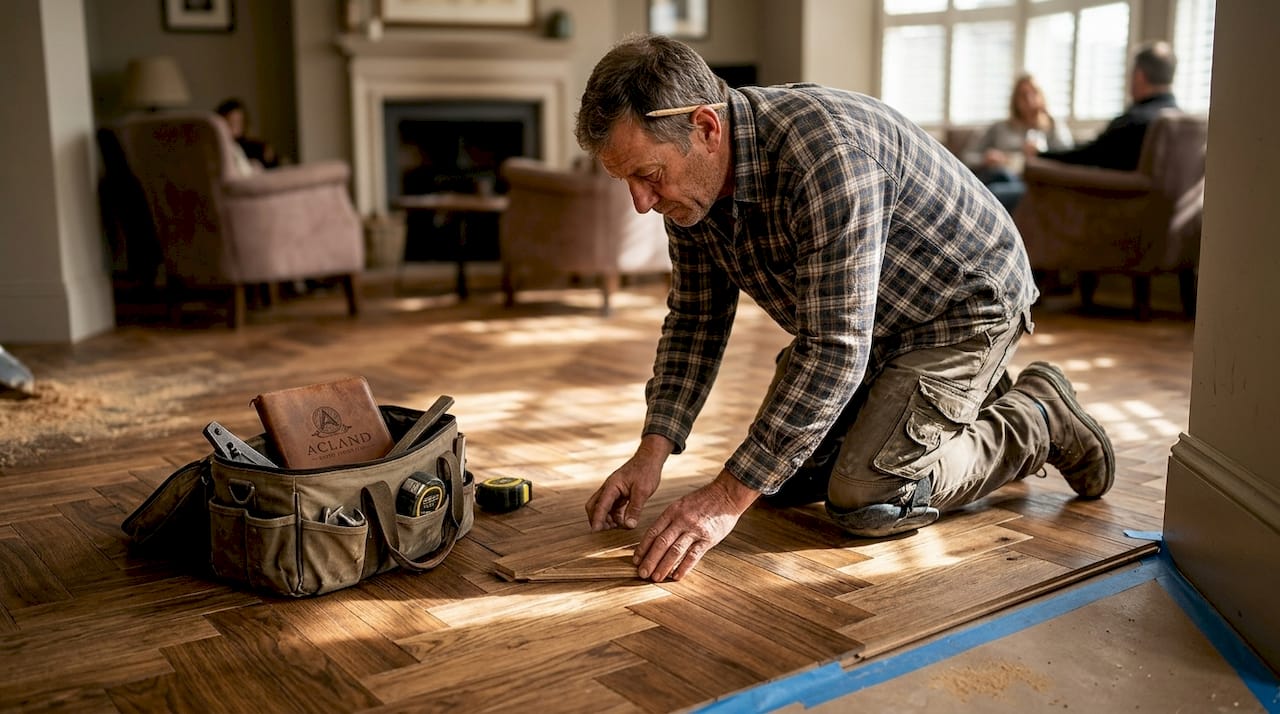
For pattern-driven designs, experienced engineered wood flooring fitters can install engineered boards in herringbone flooring patterns that create a striking visual centrepiece without the installation complexity of solid timber.
Next, let’s look at solid hardwood and assess how it compares to engineered options.
Solid hardwood: Natural luxury and resilience
Solid hardwood carries a premium feel that no other material quite replicates. Each plank is milled from a single piece of timber, which means the grain, texture, and character run through the full depth of the board. For boutique retailers, professional offices, and showrooms, that authenticity speaks volumes.
Advantages worth noting:
- Timeless appearance: Solid boards age with genuine character, developing a patina that becomes a design feature rather than a flaw.
- Refinishing potential: A solid floor can be sanded and refinished multiple times across its lifespan, correcting surface damage without full replacement.
- Species variety: Oak, walnut, and ash each bring distinct colour tones and grain patterns, allowing precise brand alignment.
- Long-term value: Well-maintained solid floors can last several decades, making them a sound long-term investment for stable commercial environments.
The trade-off is sensitivity to moisture. Solid woods provide unmatched authenticity but require careful installation to avoid moisture issues. Acclimatisation before fitting and precise subfloor preparation are non-negotiable steps. Solid hardwood suits controlled environments like offices, private clinics, or boutiques with consistent internal temperatures, rather than entrances exposed to wet Glasgow weather.
To give you a clearer comparison, the following section lines up these hardwood options side by side.
Comparison table: Engineered vs solid hardwood for business use
Here is a direct wood flooring comparison of the two main hardwood types across the factors that matter most to Glasgow businesses:
| Attribute | Engineered hardwood | Solid hardwood |
|---|---|---|
| Moisture resistance | Excellent | Moderate |
| Durability under footfall | Very high | High |
| Refinishing potential | Limited (wear layer depth) | Extensive |
| Underfloor heating compatibility | Yes | Restricted |
| Installation speed | Faster | Slower |
| Best setting | Hospitality, retail, offices | Boutiques, showrooms, offices |
| Maintenance | Low to moderate | Moderate |
| Typical lifespan | 25 to 40 years | 40 to 80 years |
“In high-traffic commercial venues across Glasgow, engineered hardwood consistently outperforms solid on stability and installation practicality. For businesses where downtime costs money, that matters as much as the look of the floor.” Acland Wood Flooring
Having compared the main types, we’ll move to guidance tailored for specific business situations.
Choosing the right hardwood for your business type
Different business environments place different demands on flooring. Here is a practical guide based on sector:
- Retail spaces: High footfall and visual impact are both essential. Engineered oak in a wide plank format offers durability and warmth. Consider herringbone for commercial settings to create a premium look that differentiates your shopfront.
- Hospitality venues: Bars, restaurants, and hotels need moisture resistance and easy cleaning. Engineered boards with a lacquered finish are the practical standard here.
- Offices: Controlled temperature and moderate footfall make solid hardwood viable. Acoustic underlays are worth budgeting for in open-plan layouts.
- Showrooms: Statement patterns like herringbone ideas or chevron add design authority that supports a premium brand position.
- Budget and timing: Always factor in installation scheduling around quieter trading periods. A phased installation plan reduces revenue loss during fitting.
Certain hardwood types are better suited for retail, hospitality, or office applications, and matching the right product to your context from the outset prevents costly modifications later.
To conclude, here’s our take on what matters most when selecting flooring for your company.
A fresh perspective on flooring for Glasgow businesses
Most guides focus on the material itself. What they overlook is the full cost picture. Installation quality, maintenance schedules, and the disruption of premature replacement all add up to far more than the price per square metre. We have seen businesses save significantly by investing in expert flooring guidance before committing to a product, rather than retrofitting advice after things go wrong. Beyond practicality, your floor is a silent brand statement. Choosing a pattern or timber species that aligns with your business identity is not an indulgence. It is smart commercial thinking.
Expert fitting and premium floors for your business
If you are ready to invest in a floor that works as hard as your business does, we are here to help. At Acland Wood Flooring, we specialise exclusively in wood floors, which means our advice is always specific and grounded in real installation experience across Glasgow and Central Scotland.
Explore our range of engineered wood fitters and solid wood specialists, or browse all of our wood flooring options to find the right solution for your premises. Book a consultation and we will come to you.
Frequently asked questions
What is the most durable hardwood floor for high-traffic businesses?
Engineered hardwood is widely regarded as the most durable and stable choice for heavy-traffic business spaces, thanks to its structured cross-layered construction that resists warping and surface wear.
Is hardwood flooring suitable for offices in Glasgow’s climate?
Yes, but engineered boards are preferred as they handle moisture better in Glasgow’s climate; always consult a local specialist to ensure correct acclimatisation and subfloor preparation before installation.
Which finishes provide the best long-term results in a commercial setting?
Matte lacquer and high-quality oils are the most practical finishes for business floors, offering durability and straightforward maintenance. Review the full range of finish and durability options to match your specific setting.
Can hardwood floors be repaired if damaged in a business premises?
Most hardwood floors, particularly solid wood floors, can be sanded and refinished several times, making them a genuinely long-term investment even after surface damage occurs.