
Most people assume wood flooring arrives at the door sanded, sealed, and ready to walk on. That assumption rules out one of the most rewarding flooring choices available to Glasgow homeowners and designers. Unfinished wood flooring starts as raw timber, and that rawness is precisely where its power lies. The finishing happens after installation, giving you control over colour, sheen, and texture that no factory process can match. This guide explains exactly what unfinished wood flooring is, why discerning clients choose it, and how the installation process actually works.
Key Takeaways
| Point | Details |
|---|---|
| Custom finish options | Unfinished wood flooring allows you to choose the exact stain, sheen, and look after installation. |
| Design flexibility | It’s perfect for matching new floors to existing interiors or specific design briefs. |
| Installation disruption | The process is more involved and requires careful timing compared to prefinished flooring. |
| Durability and repairs | Unfinished floors can usually be sanded and refinished multiple times to extend their life. |
What is unfinished wood flooring?
Unfinished wood flooring consists of raw, natural wood planks that have not yet been sanded, stained, or sealed. The finishing work is completed after the boards are installed, which is what separates it from the prefinished options you might find in a showroom.
The planks themselves are real timber. Common species include oak, ash, walnut, and maple, each offering its own grain character and density. These boards arrive on-site in their natural state, ready to be fitted and then transformed through sanding and finishing once they are in place.
Here is what sets unfinished flooring apart at a glance:
- Raw planks: no factory sanding, staining, or lacquering applied
- On-site finishing: sanding, staining, and sealing happen after installation
- Full species range: solid and engineered options both available
- Custom sheen levels: from matte and satin through to high gloss
- Seamless joins: no factory edge bevels, so the floor looks continuous
“The floor you see in its finished state is entirely the result of decisions made on-site, not in a factory. That is a meaningful distinction.”
Pro Tip: If you plan to pair your new floor with existing boards elsewhere in the home, unfinished wood makes colour matching far more achievable. Refer to our wood floor installation guide for preparation steps that support this process.
Why choose unfinished wood flooring?
The appeal of unfinished wood comes down to control. Site-finished hardwood requires installation first and then sanding and applying stain or sealer on-site, which means every decision about appearance is made in the actual space, under its actual light conditions. That is a significant advantage when you are working to a precise design brief.
Here is a comparison of the core benefits:
| Feature | Unfinished wood | Prefinished wood |
|---|---|---|
| Colour options | Unlimited on-site | Limited to factory range |
| Finish control | Full: matte to gloss | Pre-set by manufacturer |
| Seamless appearance | Yes, no bevelled edges | Micro-bevels between boards |
| Match existing floors | Highly achievable | Difficult without luck |
| Repairability | Sand and refinish entire floor | Repair only individual boards |
| Time on-site | Longer, multi-stage | Quicker to complete |
Beyond the table, the benefits play out in real scenarios. Imagine you are extending an open-plan kitchen into a previously separate dining room. The existing floor in one area is a warm mid-tone oak. With prefinished boards, you might spend hours searching for a product that is close enough. With unfinished wood, your installer mixes stain on-site until it is an exact match. The join between old and new becomes invisible.
Key practical advantages worth noting:
- Greater longevity: because the entire surface is sanded uniformly, there are no weak points from factory edge wear
- Renovation flexibility: ideal when integrating new flooring with a period property or existing timber
- Professional design alignment: interior designers can specify the exact finish during the project rather than before it begins
- Repairability over decades: a full sanding and refinish restores the floor completely
Avoiding common wood flooring errors is far easier when your finishing decisions are made on-site by an experienced fitter rather than locked in at the factory stage. The right finish choice can also dramatically affect how your flooring transforms your home’s design and long-term value.
Pro Tip: When briefing a designer or fitter, bring paint swatches and fabric samples to the site visit. Stain selection against real light in the room produces far better results than choosing from a catalogue swatch card.
Unfinished vs prefinished wood flooring: key differences
Understanding the practical differences helps you make the right choice for your project. Unfinished boards require installation first and then sanding and applying stain or sealer on-site, which adds time and stages to the process. Prefinished boards, by contrast, are sanded and lacquered at the factory, so once they are fitted, the floor is ready to use.
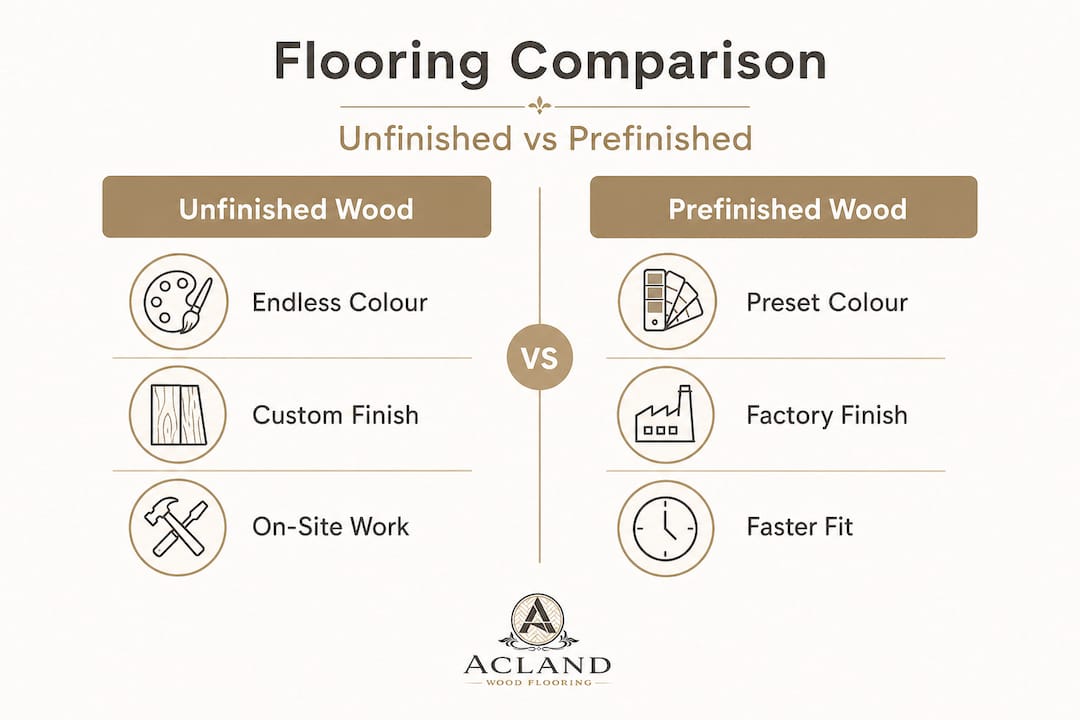
| Consideration | Unfinished | Prefinished |
|---|---|---|
| Installation stages | Fit, sand, finish | Fit only |
| Time to complete | Several days to a week | One to two days |
| Disruption level | Higher (dust, fumes) | Lower |
| Finish appearance | Seamless | Micro-bevels visible |
| Custom colour | Yes | No |
| Vulnerability during install | Higher (unsealed boards) | Lower |
During the install-to-finish gap, the unsealed material is more vulnerable to scratches and dents. This is not a reason to avoid unfinished wood, but it is a reason to plan carefully and keep foot traffic off the boards until sealing is complete.
Prefinished flooring suits projects where speed and minimal disruption matter most, such as a short renovation window in a rented property. Unfinished flooring suits projects where appearance, longevity, and seamless integration are the priority. For most residential design projects in Glasgow, those qualities are exactly what clients are looking for. Explore modern wood floor styles to see how different finishes translate across popular design schemes.
“Choosing between unfinished and prefinished is not about which is better. It is about which is right for your specific project, timeline, and design goals.”
The unfinished wood flooring installation process
Understanding the full process helps you plan around it effectively. Here is how a typical unfinished wood flooring project unfolds in a Glasgow home:
- Acclimation: boards are delivered and left in the room for at least 48 to 72 hours to adjust to the space’s temperature and humidity before any fitting begins
- Subfloor preparation: the subfloor is checked for level, moisture, and structural integrity
- Fitting: boards are laid and fixed according to the chosen pattern, whether plank, herringbone, or chevron
- Initial sanding: a coarse sanding pass removes any unevenness between boards and levels the surface
- Fine sanding: progressively finer grits create a smooth, even surface ready for finishing
- Staining (optional): colour is applied and allowed to penetrate and dry fully
- Sealing: two to three coats of lacquer, oil, or hardwax oil are applied, with light sanding between coats
- Final inspection: the finished floor is checked for consistency and any touch-ups are made
The unsealed period between installation and finishing is the most vulnerable phase. Keep pets and heavy foot traffic out of the room, and avoid any wet spillages during this window.
Glasgow’s climate introduces a specific consideration. The city’s relatively high humidity, especially in older tenement buildings, means moisture management during acclimation is essential. Boards that are not properly acclimatised can cup or gap after installation. Our guide on best wood flooring for humid climates covers this in detail, and our plank flooring installation guide explains the fitting process step by step.
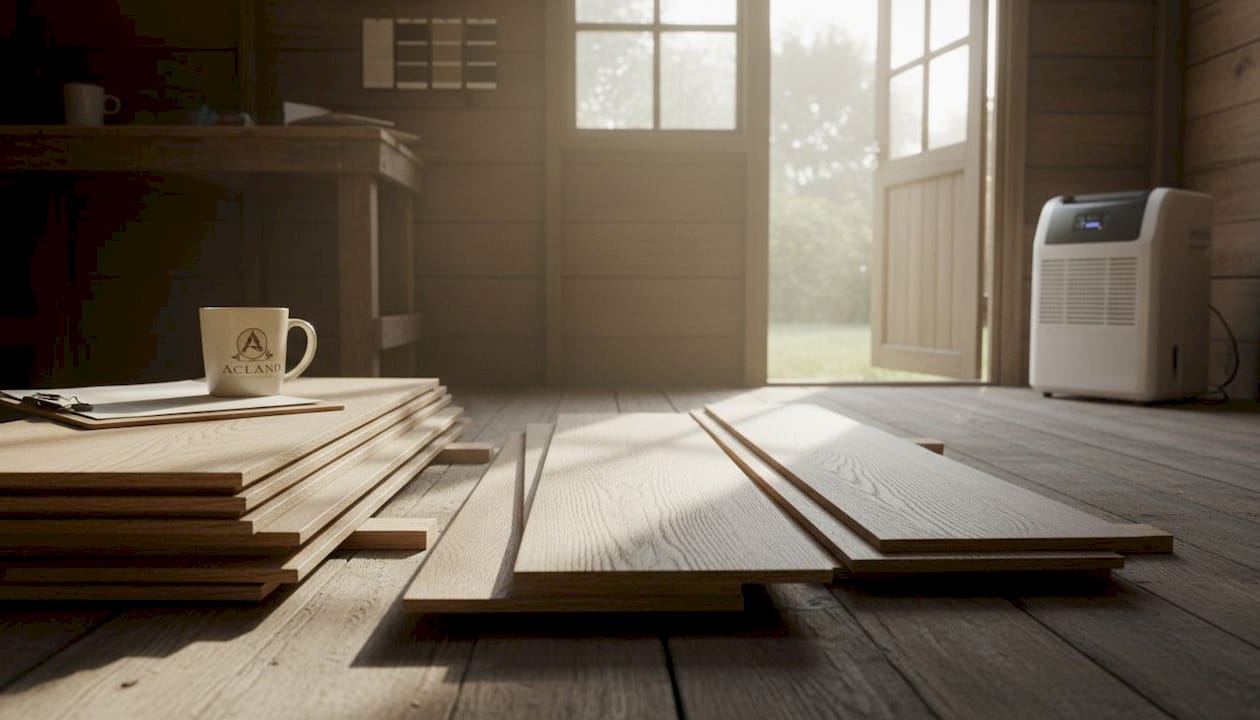
Pro Tip: Schedule unfinished floor installation during drier months where possible, or use a dehumidifier in the space during and after acclimation. This significantly reduces the risk of movement after fitting.
Design potential with unfinished wood floors
This is where unfinished wood flooring genuinely sets itself apart. On-site colour and sheen selection after installation is particularly useful for matching tones across rooms or for meeting custom interior design specifications. No two rooms are lit identically, and selecting a stain in the actual space produces a result that simply cannot be replicated from a swatch.
Design possibilities include:
- Herringbone and chevron patterns: unfinished boards lend themselves to intricate layouts because the seamless finish amplifies the geometric effect
- Wide plank floors: the absence of factory bevels makes large format planks look genuinely luxurious
- Vintage restoration: matching an unfinished floor to aged timber in a period property becomes a realistic goal rather than a compromise
- Open plan continuity: a single unfinished floor laid and finished across a large open plan space reads as one unified surface
- Bespoke sheen levels: from a barely-there matte oil finish to a rich, deep gloss lacquer, the choice is entirely yours
For designers working on residential projects across Glasgow, the herringbone floor layout workflow is a practical resource for understanding the planning and fitting demands of pattern-based designs.
What most articles miss: unfinished wood flooring in practice
Here is something most guides will not tell you plainly. The customisation benefits of unfinished wood flooring are real, but they are not the whole story. The process demands patience, careful planning, and ideally an experienced fitter who genuinely understands moisture dynamics, sanding technique, and sealing chemistry. When those elements are in place, the results are exceptional. When they are not, mistakes made at the sanding or finishing stage are costly to correct.
We see clients who have been put off unfinished wood because a previous installation was disrupted by poor planning around the unsealed period. Dust from sanding settling back into wet lacquer. Staining applied unevenly because the sanding was not thorough. These are not arguments against unfinished flooring. They are arguments for getting the right people involved from the beginning. The guidance from professional floor installation makes a genuine difference to outcomes.
The other overlooked reality is timeline management. Unfinished floors take longer. If you are renovating a property while living in it, plan for the sanding stage to generate significant dust and fumes. That means organising temporary accommodation or staging the work room by room. Done properly, with realistic expectations, unfinished wood flooring is one of the most satisfying choices you can make for a Glasgow home.
Explore your unfinished wood flooring options
Unfinished wood flooring offers genuine technical and design advantages that prefinished products cannot replicate, but achieving the best result depends on pairing the right materials with skilled installation.

At Acland Wood Flooring, we specialise solely in wood floors, which means every recommendation we make is grounded in hands-on knowledge of what works in Glasgow homes. Browse our stylish wood floor styles for design inspiration, or follow our expert floor installation guide to understand exactly what the process involves. When you are ready to discuss your project, our team is here to offer honest, practical advice tailored to your space and timeline.
Frequently asked questions
Is unfinished wood flooring more expensive than prefinished?
Unfinished wood flooring can have comparable material costs, but the on-site sanding and finishing stages mean the overall project typically involves more labour and time than prefinished installation.
How long does it take to finish an unfinished wood floor?
Most unfinished wood flooring projects take between three and seven days from fitting to a fully cured, sealed surface, depending on room size, pattern complexity, and the number of finish coats applied.
Does unfinished flooring suit Glasgow’s climate?
With proper acclimation and moisture management during installation, unfinished site-finished hardwood performs very well in Glasgow homes, particularly when installed by fitters familiar with Scotland’s humidity conditions.
Can unfinished wood flooring be sanded multiple times?
Yes, because the finishing work is done after installation and the boards retain their full timber depth, unfinished wood floors can typically be sanded and refinished multiple times over their lifespan, making them an excellent long-term investment.