
Most homeowners assume a higher grade means better, stronger wood. It doesn’t. Wood floor grading is primarily about appearance, not durability, and that single misunderstanding leads to thousands of pounds spent on material that either overshoots what a room needs or falls short of expectations. If you’re choosing or specifying wood flooring for a home or development in central Scotland, understanding how to explain wood floor grading correctly will save you money, prevent supplier disputes, and help you get exactly the floor you’re picturing.
Key Takeaways
| Point | Details |
|---|---|
| Wood floor grading defined | Grading mainly describes visual appearance, not strength or durability of wood flooring. |
| Appearance vs lumber grades | Hardwood flooring grades focus on finish looks, while lumber grades measure clear wood yield. |
| Supplier standards vary | Grading thresholds differ between suppliers, so always clarify exact definitions when buying. |
| Match grade to use | Choose rustic grades for high-traffic areas and clear grades for premium, formal spaces. |
| Specify for consistency | Developers should define grading details and request batch matching to ensure uniform floors. |
What is wood floor grading and why does it matter?
Grading, in the context of finished wood flooring, is a system for sorting planks by their visual characteristics. We’re talking about knots, streaks, colour variation, sapwood presence, and natural marks in the wood. Grading refers to appearance, not quality or durability. A rustic plank full of character marks is not weaker than a clear plank. It’s simply different in how it looks.
This distinction matters because appearance grading shapes your expectations before a single board is laid. If you order a “clear” grade expecting uniform colour and get planks with heavy streaking instead, no amount of skilled installation will fix the visual result. When assessing wood floor quality, appearance grading is one of the first things to get right.
Here’s what appearance grading actually covers:
- Knots: Size, frequency, and whether they are tight or loose
- Colour variation: How much the tone shifts between planks
- Sapwood: The lighter outer wood, which some grades allow and others restrict
- Natural marks: Mineral streaks, grain swirls, small checks or splits
- Surface uniformity: How consistent the face of each plank appears
Confusion creeps in because the same term, such as FAS, can appear in both finished flooring grades and raw lumber grades with entirely different meanings. We’ll address that directly in the next section.
Common hardwood flooring grades explained
Hardwood flooring appearance grades run from barely-there character marks to bold, rustic variation. Here’s what each level looks like in practice and where it tends to work best.
- Clear or FAS grade: Almost no knots. Consistent grain and colour. Clear grade wood is the most expensive and suits formal living rooms, offices, or high-end residential spaces where a clean, uniform look is non-negotiable.
- Select grade: A small step down. You’ll see subtle grain variation and occasional minor marks, but the overall impression remains smooth and refined. Popular for open-plan homes and modern interiors.
- #1 Common grade: Moderate knots and some colour shifting. This grade introduces genuine character without the bold drama of rustic options. Works well in family homes and traditional settings.
- #2 Common or Rustic grade: Pronounced knots, streaks, and colour variation. Rustic or Cabin grade wood is ideal for high-traffic or casual spaces because the natural variation makes everyday wear and small marks almost invisible.
- Cabin grade: The highest level of natural imperfection. Large knots, splits, and significant colour jumps. Best for utility spaces, workshops, or interiors where a rough, lived-in aesthetic is the goal.
| Grade | Knots | Colour variation | Typical cost | Best suited for |
|---|---|---|---|---|
| Clear / FAS | Minimal | Very low | Highest | Formal rooms, luxury interiors |
| Select | Very few | Low | High | Modern open-plan homes |
| #1 Common | Moderate | Moderate | Mid-range | Family homes, traditional rooms |
| #2 Common / Rustic | Frequent | High | Lower | High-traffic areas, casual rooms |
| Cabin | Extensive | Very high | Lowest | Utility spaces, rustic interiors |
Browsing wood floor style options alongside grade information helps you visualise how each level performs in a real room setting.
Understanding hardwood lumber grades and their relation to flooring
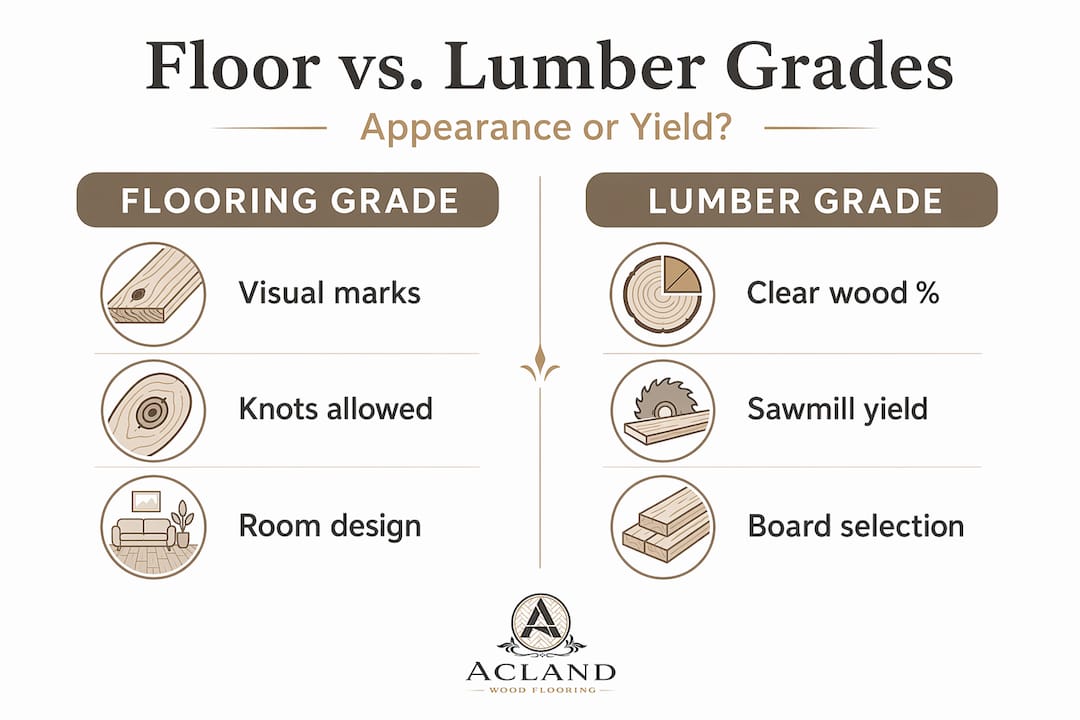
Before wood reaches a flooring mill, it exists as raw lumber. Lumber grading, governed by the National Hardwood Lumber Association (NHLA), works on a completely different principle. It measures yield, specifically how much clear, defect-free wood can be cut from a given board.
FAS lumber grade requires 83⅓% to 100% clear wood yield from a board. That tells a sawmill how efficiently a piece of timber can be processed, not what the finished floor will look like once it’s been cut, graded again for appearance, and finished.
The practical problem for buyers is that the word “FAS” appears in both systems. A supplier quoting “FAS grade” lumber and a flooring showroom advertising “FAS grade” planks are describing two different assessments of the same species. One measures raw yield potential; the other describes finished plank appearance.
Here’s a direct comparison to keep them straight:
| Grading system | What it measures | Who uses it | Key term example |
|---|---|---|---|
| NHLA lumber grading | Clear wood yield from raw board | Sawmills, timber merchants | FAS = 83⅓% clear yield |
| Flooring appearance grading | Visual character of finished plank face | Flooring manufacturers, retailers | Clear / Select / #1 Common |
Pro Tip: When requesting quotes for large projects, always ask suppliers to confirm whether their grade refers to lumber yield or finished plank appearance. The answer will change your cost estimates and your expectations of the final look.
Understanding the engineered wood flooring structure also matters here, as the wear layer on engineered boards is graded separately to the core and backing layers.
Why wood floor grading standards vary and what to ask suppliers
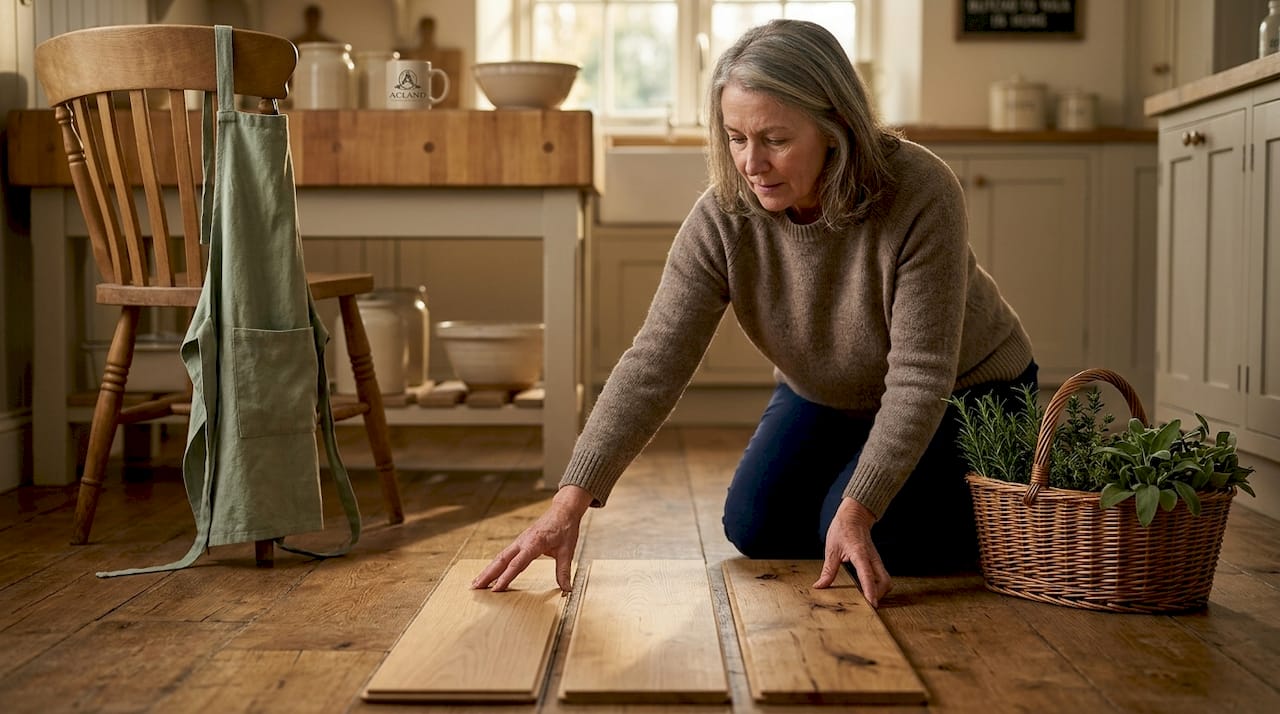
Here’s something most buying guides skip over: there is no single universal grading standard. Grade thresholds vary by supplier, meaning knot size limits, acceptable sapwood percentages, and colour variation tolerances are set independently by each manufacturer. What one supplier calls “Select” another might label “#1 Common.”
For a homeowner buying flooring for one room, slight variation between suppliers is manageable. For a developer choosing wood flooring across ten flats, that variation creates a real problem. Ordering from two batches or two suppliers using the same grade name can leave you with planks that look noticeably different when laid side by side.
To protect yourself, do the following before you commit:
- Ask for a written grade specification, including the maximum knot size in millimetres, the permitted sapwood percentage, and the range of acceptable colour variation.
- Request samples from the same batch you intend to purchase, not generic showroom displays.
- Specify batch matching in writing when ordering across phases. If phase two of a development ships from a different production run, visual drift is likely.
- Clarify whether the grade name follows any standard such as DIN (European), NHLA, or a proprietary system used by that manufacturer.
- Confirm the grading applies to the face only, not the back or edges of the plank.
Pro Tip: For phased builds or renovation projects spanning more than one room, order your full quantity from a single production batch. Storage costs are far smaller than the cost of re-flooring a room that doesn’t match.
How to choose the right wood floor grade for your home or project in central Scotland
Selecting the right grade is less about chasing prestige and less about cutting costs. It’s about matching material to purpose. Grading lets buyers match material to their actual needs, avoiding both unnecessary overspend and disappointment.
Here’s a practical process to follow:
- Decide your aesthetic priority first. Do you want a clean, uniform look or natural, characterful variation? This single decision narrows your grade range immediately.
- Consider how the space will be used. A high-traffic hallway in a family home in Glasgow benefits from a rustic grade where knots and grain movement absorb the visual impact of everyday wear. A home office or quiet master bedroom is better served by Select or Clear.
- Set a realistic budget, then work backwards. Clear and Select grades carry a premium. If budget is tight, #1 Common often offers excellent character at a lower price per square metre.
- Ask your supplier to define the grade in writing before you sign anything. Knot size, sapwood allowance, and colour range should all be stated explicitly.
- Choose an installer who understands grade sorting. Even within a graded batch, skilled installers sort planks during laying to distribute knots and colour variation evenly across the floor. This significantly improves the finished appearance.
Investing in the right grade now also protects long-term property value. A well-chosen, professionally installed floor contributes to boosting property value in ways that synthetic alternatives simply cannot match.
Why clarifying wood floor grading definitions saves money and hassle
In our experience working with homeowners and developers across central Scotland, the most avoidable flooring disputes all share the same root cause: both parties assumed a grade name meant the same thing to both of them. It rarely does.
One developer orders “rustic oak” for a new-build development in Stirling. The first phase looks beautiful. The second phase arrives from a different production run and the knots are larger, the sapwood more pronounced. The grade name was the same. The result was not. The cost of relaying a portion of the floor, not to mention the delay, ran to several thousand pounds.
The fix is straightforward but requires treating grade as a technical specification rather than a marketing label. Specifying exact grade definitions and requiring batch-matched supply is the professional approach, and it’s the standard we recommend to every client.
For homeowners planning a renovation, the same principle applies at a smaller scale. When you collect samples and sign off on a grade, ask the supplier to note the batch reference. That way, if you need additional material for repairs or extensions later, you can request material from the same run.
Understanding grading at this level of detail transforms it from a confusing number into a practical design and procurement tool. It also helps you spot when a supplier is being vague, which is often a signal worth investigating before you place a significant order. Avoiding that kind of expensive mistake is exactly what we cover in our guide to avoiding wood flooring errors.
Explore expert wood flooring solutions for your home or development
Understanding grading is one thing. Finding a supplier and installer who can translate that knowledge into a floor that looks and performs exactly as intended is another. At Acland Wood Flooring, we work with homeowners and developers across Glasgow and central Scotland to match the right grade, species, and style to each project.

Whether you’re drawn to the clean lines of Select grade oak or the characterful depth of Rustic, our team will help you understand exactly what you’re ordering before a single board arrives. Explore our range of wood floor style options for modern and traditional homes, review our wood floor installation guide for an insight into our installation standards, or discover the practical advantages of our engineered wood flooring benefits for Scotland’s climate. Get in touch with us directly to discuss your project and receive honest, specific advice from a team that specialises exclusively in wood floors.
Frequently asked questions
What does wood floor grading actually mean?
Wood floor grading sorts planks by their visual appearance, including knots, colour shifts, and natural marks. Grading reflects appearance, not the strength or structural durability of the wood itself.
How do hardwood lumber grades differ from flooring grades?
Lumber grades measure how much clear, usable wood a raw board yields during milling. FAS lumber requires 83⅓% to 100% clear wood yield, while flooring grades focus purely on how the finished plank face looks.
Why do wood floor grading standards vary between suppliers?
No universal grading standard exists, so each supplier sets their own thresholds. Grade definitions vary by supplier, making it essential to confirm knot size limits, sapwood percentages, and colour ranges in writing before ordering.
Which wood floor grade is best for high-traffic family homes?
Rustic or #2 Common grades are the strongest choice for busy family homes because their natural character hides everyday wear far better than a uniform clear grade. Rustic planks hide damage well and tend to cost less than higher grades, making them excellent value for hallways and living areas.
How can developers ensure consistent wood floor appearance across multiple units?
Specify exact grading criteria in writing, including maximum knot sizes and sapwood limits, and request matching or same-batch supply for all phases. Specifying exact definitions and requiring matching supply prevents visual drift between units or across different phases of a build.