Choosing a wood floor pattern is one of the most consequential design decisions you will make in a room. Get it right, and the floor sets the entire tone. Get it wrong, and no amount of expensive furniture will fix it. The good news is that wood floor patterns examples range from the beautifully simple to the spectacularly complex, giving you genuine options whatever your budget, room size, or style preference. This guide walks you through the main types of wood flooring designs, what they cost, how they perform, and how to choose the right one with confidence.
Key takeaways
| Point | Details |
|---|---|
| Pattern affects perception | Pattern choice influences how large, wide, or long a room appears to the eye. |
| Straight lay suits most rooms | Straight lay costs £3 to £7 per sq ft and works across nearly every room type and plank width. |
| Complex patterns mean more waste | Chevron and Versailles generate 15 to 20% material waste, so always budget for extra boards. |
| Species matters as much as pattern | European oak is the benchmark choice for herringbone and parquet, balancing durability with cost. |
| Installation skill changes everything | Patterns like chevron and Versailles demand a level subfloor and an experienced installer to avoid visible errors. |
How to choose a wood floor pattern: key criteria
Before you browse wood floor pattern ideas, a few practical factors should shape your decision. Skipping this stage is how people end up with a stunning floor that feels wrong in the room.
Room size and shape. Smaller rooms suit tighter, textural patterns like herringbone and basket weave, which add texture without overwhelming space. Large, open areas carry bolder layouts like chevron or mansion weave far more comfortably.
Architectural style. A Versailles parquet looks extraordinary in a Georgian townhouse and awkward in a 1970s semi. Match the pattern ambition to the character of the building.
Budget. This is where most people underestimate costs. Material price is just part of the equation. Labour, subfloor preparation, and offcuts all add up, especially with complex patterns.
Installation complexity. Some patterns require a specialist. If you use a general contractor for a chevron or Versailles floor, the result will show it.
- Consider the direction of natural light, as diagonal patterns can shift how light moves across a floor
- Check whether your subfloor is level. Parquet patterns will show every imperfection
- Think about wood species and finish together. A pale oak in a basket weave reads very differently to a smoked oak in the same layout
- If you are a renter, check for floating floor options, since engineered herringbone can be floated over existing subfloors without permanent fixing
Pro Tip: Order a minimum of 10% extra material for straight lay floors and 15 to 20% for patterned floors. Running out mid-installation risks mismatched batches, which can cost significantly more to resolve than buying extra upfront.
Classic wood floor patterns examples: straight lay, diagonal, and brick bond
These are the foundations of wood flooring design, and they remain popular for good reason.
Straight lay is the most affordable and versatile pattern, costing roughly £3 to £7 per square foot for materials. Boards run parallel to the longest wall, creating a clean, unfussy result. It works equally well in period homes and contemporary spaces, and almost any plank width suits it. Waste sits at around 10%, making it the most cost-efficient choice.
Diagonal is simply straight lay rotated 45 degrees, but the visual effect is meaningfully different. The angled lines draw the eye across the room rather than along it, making spaces feel broader. It suits medium-sized rooms particularly well and adds visual interest without the cost of a parquet pattern. Expect slightly more waste than straight lay due to angled cuts along the walls.
Brick bond offsets each row by half a board length, mimicking the look of brickwork. The result is a calm, rhythmic pattern that reads as contemporary yet timeless. It suits wide planks especially well and works beautifully in kitchen-diners and open plan living areas.
- Straight lay: best for hallways, bedrooms, and large open spaces
- Diagonal: excellent for square rooms that need visual direction
- Brick bond: ideal for wide-plank floors in modern or Scandi-style interiors
Elegant parquet patterns examples: herringbone, chevron, and Versailles
These are the patterns that make people stop and look down. Each has a distinct character, and each comes with its own cost and installation demands.
Herringbone arranges rectangular blocks in a zigzag where each piece meets its neighbour at a 90-degree angle. It is genuinely timeless and, as the research confirms, suitable for both traditional and contemporary interiors. European oak is the benchmark species for herringbone, with a Janka hardness of 1360 and warm tones that suit most colour schemes. Material waste typically runs at 10 to 15%.
Chevron creates a continuous V-shape by cutting boards at a precise angle so the points meet perfectly. It looks sharper and more modern than herringbone, but that precision costs money. Chevron generates 15 to 20% waste compared to herringbone’s 10 to 15%, and the price difference for a 500 square foot room can reach £3,000 to £5,000. The subfloor must be immaculately level; any deviation becomes visible in the finished pattern.
Versailles is the grand statement of parquet flooring. Interlocking squares of smaller pieces create a regal, symmetrical design historically associated with formal European interiors. Labour alone costs £10 to £20 per square foot for Versailles installation, compared to £5 to £12 for standard parquet. It is a long-term investment, best suited to reception rooms and hallways where it will be seen and appreciated daily.
| Pattern | Material waste | Labour complexity | Best room type |
|---|---|---|---|
| Herringbone | 10 to 15% | Moderate | Living rooms, hallways, bedrooms |
| Chevron | 15 to 20% | High | Open-plan spaces, dining rooms |
| Versailles | 20%+ | Very high | Reception rooms, formal dining |
Pro Tip: For a herringbone floor in a smaller room, choose a narrower block width, around 70mm to 90mm. Wider blocks in a small space can make the pattern feel clunky rather than elegant.
Modern and unique wood floor pattern ideas: basket weave, mosaic, mixed-width, and geometric
Not every great floor is a herringbone. These patterns are gaining ground, and for good reason.
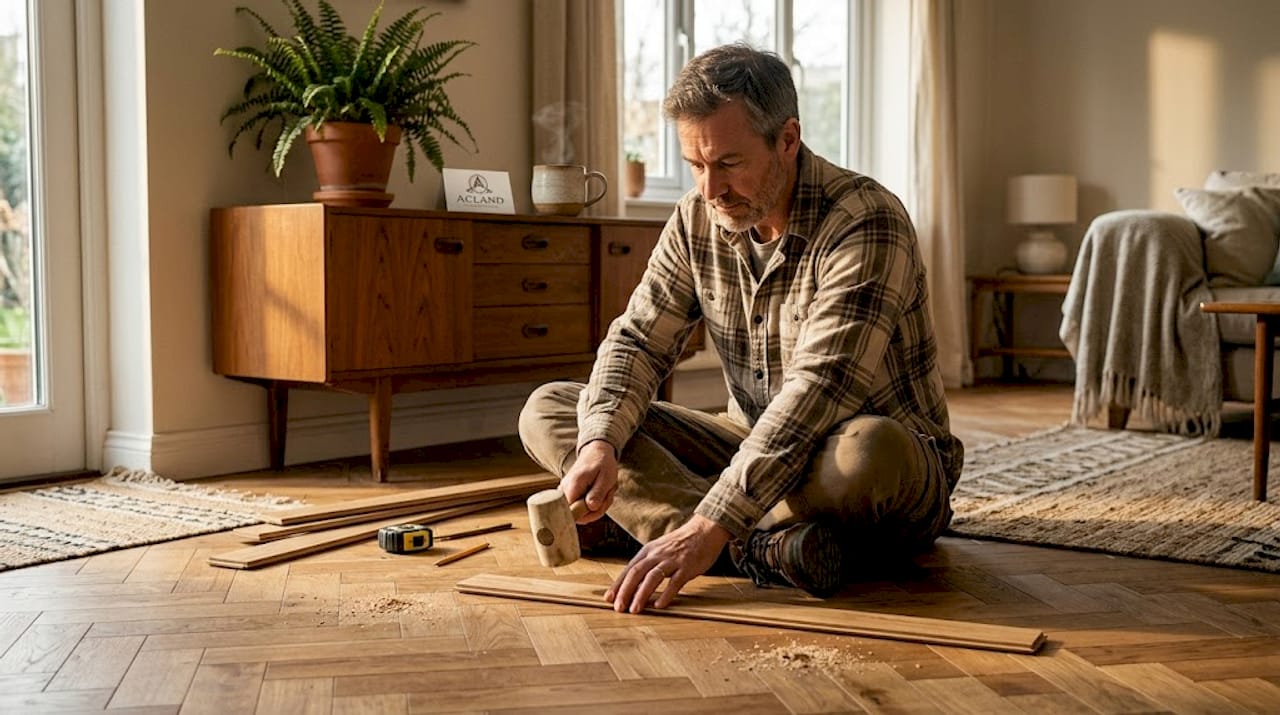
Basket weave pairs small groups of parallel boards at right angles to one another, creating the impression of woven material. It is subtler than chevron and suits rooms where you want texture without drama. Basket weave and mosaic parquet offer more affordable alternatives to classic herringbone, which makes them worth serious consideration if budget is tight.
Mosaic parquet uses very small wood fingers arranged in geometric blocks. It has a retro quality that works surprisingly well in contemporary interiors and tends to cost less than larger parquet patterns because the small pieces reduce offcut waste.
Mixed-width planks combine two or three different board widths in the same floor. The result feels organic and handcrafted, suiting farmhouse kitchens, barn conversions, and heritage properties. It pairs especially well with wire-brushed or hand-scraped finishes. For more ideas on matching floors to furniture, thinking about both texture and tone together pays dividends.
- Basket weave: suits studies, snugs, and rooms with traditional furniture
- Mosaic parquet: works well in period flats and compact reception rooms
- Mixed-width planks: best for rustic, farmhouse, or heritage-style spaces
- Geometric layouts: bold diamond or hexagonal arrangements for feature areas like hallways or kitchen floors
Comparing pattern options: cost, complexity, and suitability
This table gives you a practical side-by-side view across the main wood floor pattern types.
| Pattern | Approx. material cost per sq ft | Installation skill level | Typical material waste | Room size suitability |
|---|---|---|---|---|
| Straight lay | £3 to £7 | Low | 10% | Any |
| Diagonal | £3 to £8 | Low to moderate | 12 to 15% | Small to medium |
| Brick bond | £3 to £8 | Low | 10 to 12% | Medium to large |
| Herringbone | £7 to £15 | Moderate | 10 to 15% | Small to large |
| Chevron | £9 to £18 | High | 15 to 20% | Medium to large |
| Basket weave | £5 to £12 | Moderate | 10 to 15% | Small to medium |
| Versailles | £15 to £30+ | Very high | 20%+ | Large, formal |
The numbers above reflect materials only. Labour adds significantly to complex patterns, and subfloor preparation can add further cost if levelling is required. Precision and consistency are non-negotiable for patterns like chevron and Versailles, so cutting corners on installation will show up clearly in the finished floor.
My honest take on choosing a wood floor pattern
I have seen people spend more on a Versailles floor than on their kitchen renovation, and I have also seen a beautifully executed straight lay in European oak outshine it completely. The pattern itself is rarely the whole story.
What I have learned is that the two most underestimated factors are subfloor quality and installer experience. You can specify the most beautiful pattern in the world, but if the subfloor is not level or the installer is not experienced with that specific layout, the result will disappoint. This is especially true for chevron, where even a small deviation in the angle becomes glaringly visible across an open room.
The other thing I would say is this: do not dismiss the classics. Herringbone remains genuinely timeless, which matters enormously if you plan to sell the property one day. Bold or unusual patterns can be stunning, but they can also date quickly or limit your buyer pool. If you are unsure, lean towards the pattern that has been beautiful for 300 years rather than the one that appeared in a design magazine last spring.
— John
Let Aclandwoodflooring help you find the perfect pattern
Whether you are drawn to the quiet elegance of herringbone or the drama of a Versailles parquet, the right pattern comes down to your space, your budget, and the quality of the installation. At Aclandwoodflooring, we work with homeowners across Glasgow to match the right pattern to the right room, every time.

From wood floor design ideas that suit modern Scottish homes to detailed chevron installation guidance from specialists who work with these patterns daily, we cover every step of the process. Our team also offers honest advice on wood floor styles and species selection, so you spend your budget where it makes the most difference. Get in touch with Aclandwoodflooring for a free consultation and take the guesswork out of your flooring decision.
FAQ
What are the most popular wood floor patterns?
Herringbone, chevron, and straight lay are consistently the most popular choices. Straight lay suits most budgets and rooms, while herringbone and chevron suit those seeking a more characterful finish.
Is chevron more expensive than herringbone?
Yes. Chevron costs 15 to 25% more than herringbone due to precise angled cuts that increase material waste to 15 to 20% compared to herringbone’s 10 to 15%.
Which wood floor pattern makes a small room look bigger?
Diagonal and herringbone patterns both help small rooms feel larger by drawing the eye across the space rather than emphasising its boundaries.
Can I install patterned wood floors over underfloor heating?
Yes, with the right product. Engineered herringbone can be glued or floated over radiant heat systems, whereas solid wood herringbone requires nail-down or glue-down installation on a wood subfloor.
How much extra material should I order for a patterned floor?
Order at least 10% extra for straight lay and 15 to 20% extra for complex patterns like chevron and Versailles. Running out mid-installation risks mismatched batches that are costly and difficult to resolve.