
Scotland’s damp, mild climate is one of the most demanding environments for wood flooring in the UK. Most failures happen not because of poor wood quality, but because homeowners and builders underestimate the role of climate in wood flooring choice. Wood is a living material. It responds to every shift in humidity and temperature, expanding, contracting, and warping if the conditions are wrong. Get the climate control right before, during, and after installation and your floor will perform beautifully for decades.
Key takeaways
| Point | Details |
|---|---|
| Climate drives wood movement | Wood expands and contracts with humidity changes, making indoor RH control critical before and after installation. |
| Acclimatise before fitting | Store wood on site at the correct temperature and humidity for the recommended period to prevent post-install movement. |
| Engineered wood suits Scotland | Engineered construction resists moisture-driven movement better than solid wood in Scotland’s variable indoor climate. |
| UFH needs careful specification | Underfloor heating accelerates moisture loss; keep floor surface temperature below 27°C and warm up gradually. |
| Wide planks amplify risk | Wider boards require tighter moisture content matching between wood and subfloor to avoid cupping and gapping. |
The role of climate in wood flooring choice
Wood is hygroscopic. That means it constantly absorbs and releases moisture from the surrounding air, and it changes shape as it does. When indoor relative humidity (RH) rises, wood fibres absorb moisture and the boards swell. When RH drops, wood dries out and boards shrink. The technical term for the moisture level wood settles at in a given environment is equilibrium moisture content (EMC), and it governs everything about how your floor behaves long-term.
Scotland’s climate creates particular challenges. Outdoors, the weather is cool and frequently wet. Indoors, seasonal RH swings are significant: centrally heated homes in winter can see RH fall sharply as heating dries the air, while summer months bring higher ambient humidity. These fluctuations create seasonal cycles of expansion and contraction that stress every wood floor in the country.
The consequences of getting this wrong are visible and costly:
- Cupping: Boards curve upward at the edges when the underside absorbs more moisture than the surface.
- Gapping: Boards pull apart at the joints when RH drops too low, leaving visible gaps.
- Crowning: The centre of each board rises above the edges, usually after poorly managed moisture remediation.
- Mould growth: Wood moisture above 16% creates conditions where mould can develop beneath or within boards.
The target indoor RH for wood flooring in UK homes sits at 40 to 65% RH. Below 40%, shrinkage and gapping become likely. Above 65%, expansion, cupping, and moisture damage follow. Scottish homes, with their characteristically damp autumns and dry heated winters, frequently push against both ends of that range across a single year.
Acclimatisation: preparing your site correctly
Acclimatisation is the process of allowing wood flooring to adjust its moisture content to match the environment where it will live permanently. Skip it and you are installing a floor that will continue moving after it is fixed in place. The results are predictable and expensive.
Follow these steps to acclimatise wood flooring properly for a Scottish property:
- Stabilise the building first. The home must be weather-tight, with heating running consistently for at least five days before the wood arrives on site. Wet trades such as plastering and screeding should be fully dry for four to six weeks prior to delivery.
- Target the correct conditions. Maintain 30 to 50% RH and 15 to 27°C for at least 48 hours before the wood is delivered. These conditions should be sustained throughout installation and afterwards.
- Allow adequate waiting time. Solid wood typically needs longer to acclimatise than engineered wood, often five to seven days minimum, sometimes more in very damp Scottish properties. Engineered boards are more forgiving but still require time on site.
- Store boards correctly. Stack them flat in the room where they will be installed, not in a garage or outbuilding. The micro-climate of the actual room is what matters.
- Monitor with a hygrometer. Do not rely on guesswork. A hygrometer costs very little and tells you exactly what conditions the wood is adjusting to.
- Check subfloor moisture content. Use a moisture meter on both the boards and the subfloor. For stable performance, the two readings should be within two to four percentage points of each other.
Pro Tip: Do not turn heating off after installation to save energy. Sudden drops in RH after fitting are one of the most common causes of gapping in Scottish homes. Consistency matters far more than the absolute temperature.
You can read more about this process in Aclandwoodflooring’s dedicated guide on acclimatising floors in Glasgow.
Choosing the right wood species and construction
Not all wood flooring handles Scotland’s variable humidity equally. The two biggest decisions are construction type and species, and they interact with each other.
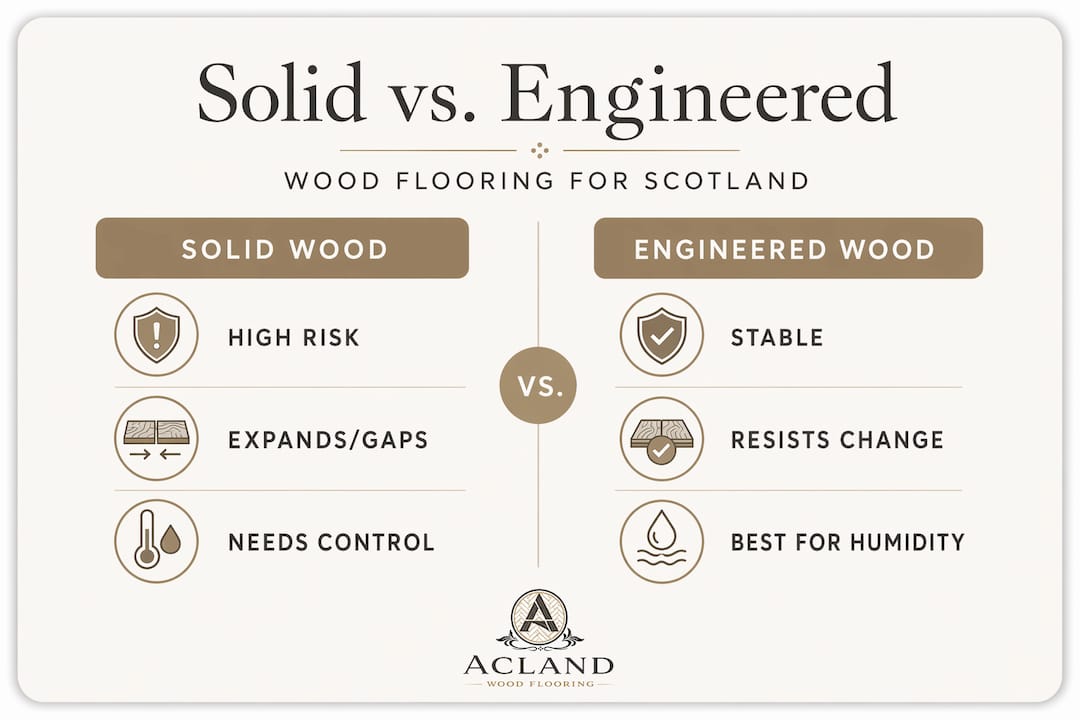
Engineered wood flooring offers better dimensional stability than solid wood in humidity-variable climates. Its cross-ply construction counteracts the natural tendency to expand and contract along the grain, making it the more reliable choice for most Scottish homes. Solid wood is not unsuitable, but it demands tighter and more consistent climate control to perform well long-term.
Plank width is the other variable that most people overlook. Wide-plank hardwood requires flooring moisture content within 2 to 4% of the subfloor to avoid cupping and gapping. A wider board has more surface area reacting to humidity changes, so any imbalance is amplified. In a home where RH control is inconsistent, a 90mm engineered oak board will outperform a 180mm solid oak board significantly.
The table below outlines common species and constructions and their suitability for Scotland’s conditions:
| Species and construction | Moisture stability | Suitability for Scotland |
|---|---|---|
| Engineered oak (multi-ply) | High | Excellent. Works well across most Scottish homes. |
| Engineered walnut (multi-ply) | High | Very good. Stable with good site preparation. |
| Solid oak (narrow plank) | Moderate | Good with consistent RH control and full acclimatisation. |
| Solid ash (wide plank) | Lower | Riskier. Needs very tight moisture management throughout. |
| Solid pine (wide plank) | Low | Challenging. Prone to movement; needs expert installation. |
For detailed guidance on flooring choices for humid climates in Glasgow specifically, Aclandwoodflooring has published a resource worth reading before you decide on a species.
Underfloor heating and wood flooring
Underfloor heating has become increasingly popular in Scottish new-builds and renovations, often paired with sustainable home heating systems that run at lower flow temperatures. The good news is that wood flooring is compatible with UFH when specified correctly. The bad news is that UFH accelerates the very problem wood flooring is most vulnerable to: moisture loss and dimensional movement.
Key considerations when combining UFH with wood flooring:
- Respect the 27°C limit. The maximum recommended floor surface temperature is 27°C. Above this, wood dries too rapidly and the risk of cracking and separation rises sharply.
- Choose engineered over solid. Engineered wood tolerates the thermal cycling of UFH far better than solid timber. The cross-ply construction limits the movement that heat-driven moisture loss would otherwise cause.
- Warm up gradually. At the start of the heating season, raise the floor temperature slowly over several days rather than switching straight to full output. Thermal shock is a real and avoidable cause of floor damage.
- Commission the system before installation. Run the UFH at operating temperature for at least 14 days before the wood goes down, then switch it off and allow the floor to cool before fitting begins.
Pro Tip: If you are specifying a kitchen or bathroom adjacent to a living area with UFH, pay close attention to how kitchen flooring choices handle moisture at transitions. Moisture from adjacent rooms migrates and can undermine an otherwise well-specified installation.
Aclandwoodflooring’s guide on specifying wood for UFH covers the full specification process in detail.
My perspective on Scottish wood flooring failures
I have seen the same mistakes made repeatedly on Scottish projects, and nearly all of them come down to impatience. Someone finds a beautiful wide-plank solid oak floor, orders it, and wants it fitted the following week. The plasterer finished two weeks ago. The heating has not been running steadily. No one has checked the subfloor moisture content.
Six months later, there are gaps you could lose a pound coin in.
My view is that engineered wood is the genuinely sensible choice for the majority of Scottish homes, not as a compromise but as the correct specification for the environment. Ignoring moisture-content tolerances leads to premature floor failure, and Scotland’s climate gives you less margin for error than drier parts of the UK.
The other thing I have learned is that success in this climate is less about achieving a perfect RH number on one day and more about minimising the swings over time. A home that sits reliably between 45 and 55% RH is far kinder to wood floors than one that cycles between 35% in February and 70% in September. Invest in a decent hygrometer, keep heating consistent through winter, and give your floor time to acclimatise properly. Those three things prevent most of the failures I see.
— John
Expert flooring solutions for Scotland’s climate

Aclandwoodflooring works exclusively with wood flooring, which means every recommendation is grounded in genuine knowledge of how different species and constructions perform in Scottish conditions. Whether you are choosing between solid and engineered options, specifying a floor over UFH, or simply trying to understand which species will handle your home’s humidity profile, the team offers honest, experience-based guidance rather than a sales pitch.
Explore the engineered wood flooring guide for a thorough breakdown of construction types and performance characteristics. For installation method detail, the wood floor layering guide covers everything from floating to fully bonded methods and which suits your subfloor and climate conditions. Get in touch with Aclandwoodflooring directly for bespoke advice tailored to your property and project.
FAQ
What RH should my home be before installing wood flooring?
Indoor relative humidity should sit between 40 and 65% before wood flooring is installed, with 45 to 55% being the ideal target. The heating should have been running steadily for at least five days, and all wet trades should be fully dry.
Is solid or engineered wood better for Scottish homes?
Engineered wood is generally the better choice for Scotland’s variable humidity. Its cross-ply construction resists moisture-driven movement more effectively than solid wood, making it more stable across seasonal changes.
How long does wood flooring need to acclimatise?
Solid wood typically needs five to seven days on site at the correct temperature and humidity before installation. Engineered wood requires less time but should still be left in the room for a minimum of 48 hours.
Can I use wood flooring with underfloor heating?
Yes, but the floor surface temperature must not exceed 27°C, and engineered wood is strongly preferred over solid wood on UFH systems. The heating should be commissioned and then switched off before installation begins.
Why do wide-plank floors gap more than narrow ones?
Wider boards have a larger surface area reacting to humidity changes, which amplifies any moisture content mismatch between the wood and subfloor. NWFA guidelines recommend the two readings be within 2 to 4% of each other to prevent gapping and cupping.