
Many Glasgow homeowners are surprised to learn that perfectly good wood flooring can warp, buckle, or gap within weeks of installation, not because of poor materials, but because the wood was never given time to adjust to its surroundings. Scotland’s variable climate creates real risks for any wooden floor laid without proper preparation. Acclimatisation, the process of allowing wood to settle into the temperature and humidity of a room before it is fixed in place, is one of the most important and most overlooked steps in any flooring project. Get it right and your floor can last decades. Skip it and you may be looking at costly repairs far sooner than you planned.
Key Takeaways
| Point | Details |
|---|---|
| Preparation prevents damage | Proper acclimatisation ensures wood flooring adapts to Glasgow’s climate, preventing costly flaws. |
| Both floor types need acclimatisation | Solid and engineered wood floors require climate adaptation before installation for lasting stability. |
| Local humidity matters | Glasgow’s environment makes humidity control essential for wood flooring performance. |
| Skip acclimatisation, risk issues | Failure to acclimatise risks gaps, warping, and reduced floor lifespan, affecting both value and appearance. |
| Expert help is available | Professional installation services can ensure your wood flooring is ready for Scotland’s unique climate challenges. |
What does acclimatising wood flooring mean?
Acclimatisation means placing your wood flooring materials inside the room where they will be installed and leaving them there long enough to absorb the ambient temperature and humidity of that space. Wood is a natural material. It expands when it absorbs moisture and contracts when it dries out. If you install boards that have been stored in a dry warehouse and immediately lay them in a Glasgow home during a wet autumn, the wood will begin drawing in moisture from the air and swelling after installation. The result is buckling, raised edges, or tight joints that crack under pressure.
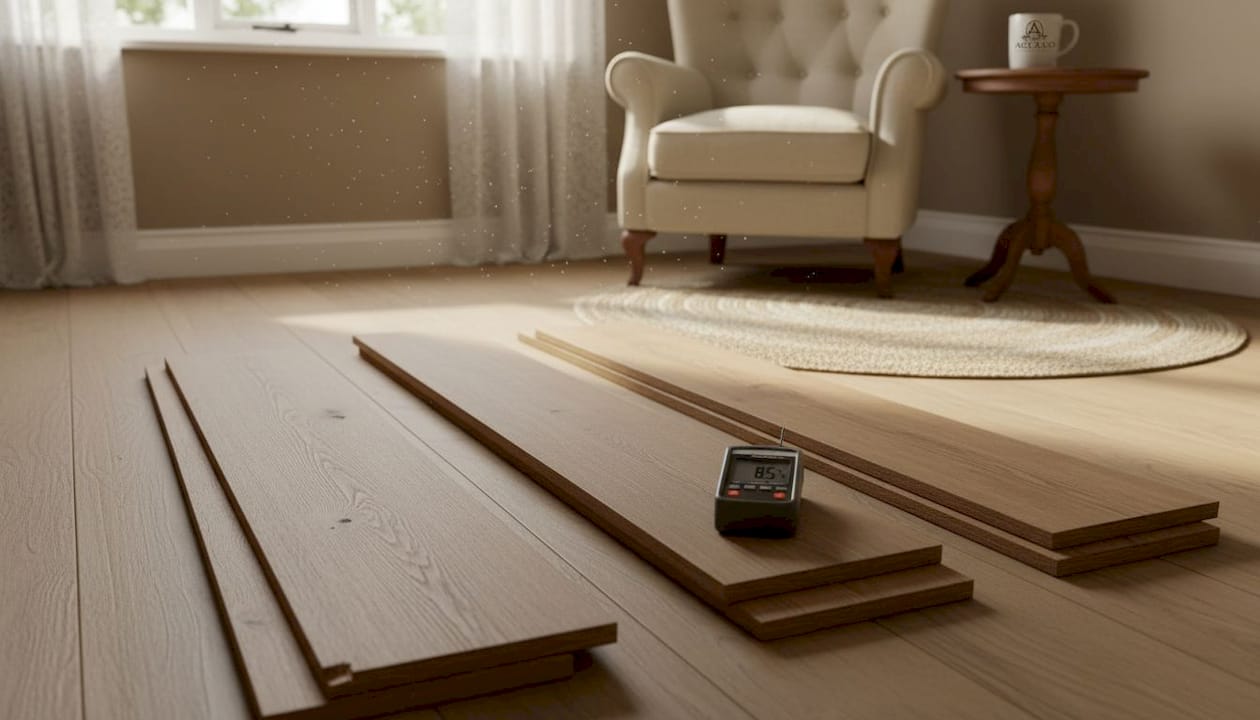
This process applies to both solid hardwood and engineered wood floors. Many people assume engineered boards, which have a real wood veneer bonded to a plywood core, are immune to moisture movement. They are more stable, yes, but they still need time to adjust. As the commercial wood flooring guide outlines, proper handling and acclimatisation of wood flooring before installation is essential regardless of the product type, whether for a domestic sitting room or a busy commercial space.
Key reasons acclimatisation is non-negotiable in Glasgow:
- Glasgow’s average indoor relative humidity fluctuates significantly across seasons
- Wood delivered from factories or warehouses is conditioned to generic storage conditions, not your specific property
- Even a small mismatch in moisture content between the boards and the subfloor can cause long-term instability
- Properties in older Glasgow tenements or Victorian terraces often have unique ambient conditions that differ from new builds
For a fuller understanding of what correct preparation looks like in practice, the wood floor installation guide covers each preparation stage in detail. It is also worth understanding how environmental humidity affects building materials more broadly, as wood is particularly sensitive compared to tile or stone.
Why acclimatisation matters in Glasgow’s climate
Glasgow sits on the west coast of Scotland, which means it receives a higher annual rainfall than most UK cities and experiences frequent humidity swings throughout the year. The city averages around 170 days of rainfall per year. Indoor humidity levels can shift dramatically between a wet November and a dry February when central heating runs constantly. These swings directly affect the moisture content of any wooden material inside a building.
The environmental impact on wood flooring is well documented, with research confirming that fluctuating humidity in construction environments causes measurable dimensional changes in timber. This is not a minor technical concern. A solid oak board that has not acclimatised can expand by several millimetres across its width during a humid period, pushing against adjacent boards or skirting boards and causing visible damage.
| Season | Typical indoor humidity in Glasgow | Risk to non-acclimatised floors |
|---|---|---|
| Summer | 50% to 60% | Moderate expansion risk |
| Autumn | 60% to 75% | High moisture absorption risk |
| Winter (heated) | 35% to 50% | Contraction and gapping risk |
| Spring | 55% to 70% | Variable movement risk |
The table above shows why a floor installed in January behaves very differently from one installed in October. Non-acclimatised boards may cope in summer but fail badly when autumn humidity rises. Common problems seen in Glasgow properties include cupping (where board edges rise higher than the centre), gapping between boards during dry winter months, and general instability that worsens over time.
These are exactly the types of wood flooring errors that professional installers work hard to prevent. If you are considering a floor in a kitchen, bathroom-adjacent space, or a room with underfloor heating, understanding wood flooring for humid spaces becomes even more critical. The impact of humidity on property maintenance is something every Glasgow homeowner should factor in from the start.
Pro Tip: Before installation begins, use a hygrometer (a simple, inexpensive humidity measuring device) to record indoor humidity levels across several days. This tells you what conditions your floor will actually live in, not what the calendar suggests.
Consequences of skipping acclimatisation
Understanding the risks is one thing. Seeing what actually goes wrong brings the message home more clearly. Here is what happens when acclimatisation is skipped or cut short:
- Cupping and crowning — Boards absorb or release moisture unevenly, causing edges to curl up or the centre of the plank to dome
- Gapping — Boards shrink during dry periods, leaving unsightly gaps between planks that collect dirt and debris
- Buckling — Severe expansion causes boards to lift entirely from the subfloor, creating a dangerous and very costly problem
- Cracking — Rapid drying after installation leads to splits along the grain of the wood
- Joint failure — Tongue-and-groove joints crack or loosen when boards move beyond their designed tolerance
“We have seen beautiful, expensive floors completely ruined within a single season because the installation skipped acclimatisation. It is not a step you can shortcut. The climate in Glasgow will find every weakness in a floor that was not prepared properly.” — Acland Wood Flooring installation specialist
The financial consequences are significant. Replacing or repairing a warped floor often costs as much as the original installation. For property developers, it can delay a sale or rental and affect property value considerably. The relationship between acclimatisation and long-term floor performance is clear: boards that go through correct preparation simply last longer. Understanding moisture damage in timber elements such as skirting boards is equally important, as the same risks apply throughout any wood installation.
How to acclimatise wood flooring step by step
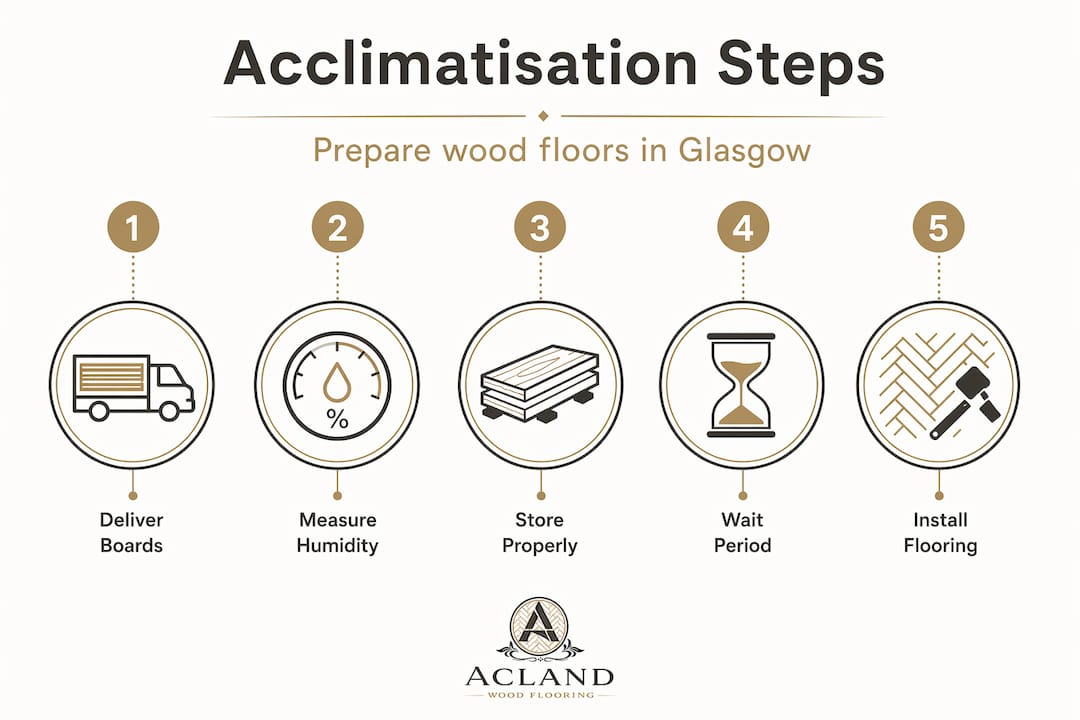
Getting acclimatisation right is straightforward when you follow a consistent process. Here is how to do it properly for Glasgow properties:
- Deliver the boards to the correct room, not a garage or hallway. The boards must acclimatise in the specific environment where they will be installed
- Remove or open the packaging so air can circulate around the boards. Stack them in small cross-piled groups rather than leaving them flat in a sealed bundle
- Ensure the room is at its normal operating temperature. Turn on central heating or climate control as you would when the room is in regular use
- Leave the boards for at least 48 to 72 hours as a minimum. In older Glasgow properties with thick stone walls or unusual ventilation, extending this to five to seven days is advisable
- Check subfloor moisture content using a moisture meter before laying. The subfloor and the boards should have closely matched moisture content readings
- Do not acclimatise during building work that creates unusual moisture levels, such as fresh plastering or concrete screed that has not fully cured
| Factor | Solid wood | Engineered wood |
|---|---|---|
| Minimum acclimatisation time | 5 to 7 days | 48 to 72 hours |
| Sensitivity to humidity swings | High | Moderate |
| Recommended room humidity | 40% to 60% | 40% to 65% |
| Subfloor moisture tolerance | Narrow | Broader |
The commercial wood flooring guide provides specific guidance for acclimatisation in larger spaces and commercial settings, where conditions can be even harder to control. Choosing the right product from the start also matters. Expert advice on premium wooden floors can help you match the species and construction of the board to the demands of each room. If you are unsure which product suits which area of your home, the wood flooring room guide is an excellent starting point. For rooms with persistent damp issues, anti-humidity treatment for subfloors or walls should be addressed before any flooring is laid.
Pro Tip: Never acclimatise boards in a room that has been freshly plastered or where the screed is less than four weeks old. Residual construction moisture will distort the wood’s natural moisture content and undermine the entire process.
Does acclimatisation really make a difference? A Glasgow expert’s view
There is a tempting logic to skipping acclimatisation. The boards look fine in the packet. The room feels dry enough. The schedule is tight and the client wants the floor finished. We hear it regularly. And we understand the pressure. But in Glasgow, cutting this step is one of the most reliable ways to guarantee a problem floor.
What we see in practice is that properties with older fabric, particularly tenements, sandstone semis, and Victorian terraces, hold moisture in ways that modern dry-lined new builds do not. A floor that acclimatises for 72 hours in a new build on the south side of the city might need a full week in a ground-floor flat in Partick or Dennistoun with solid external walls. There is no single formula that fits every Glasgow property. This is precisely why experience and local knowledge matter so much.
We have spoken to clients who were advised by well-meaning friends to “just lay it and it’ll settle.” In every single case where acclimatisation was skipped in favour of speed, the floor showed problems within a season. One client had a beautiful herringbone oak floor installed before a house sale. The boards were not acclimatised properly and by the time viewers came through, the floor was visibly gapping. It cost the seller both time and money to fix. The benefits of professional installation go well beyond the laying itself. An experienced installer will insist on doing acclimatisation properly, even when a client is keen to push ahead.
Get help with wood flooring acclimatisation and installation in Glasgow
At Acland Wood Flooring, we make sure every project starts with the right foundation, and that includes proper acclimatisation as standard. Whether you are choosing between products suited to Glasgow’s damp climate or browsing modern wood floor styles for your next renovation, our team is here to give honest, practical guidance from day one.

We cover every stage of the process, from helping you select the right product to ensuring installation meets the highest standards. Our flawless installation guide is available for homeowners who want to understand each step before work begins. Get in touch with us to discuss your project and ensure your floor is prepared, acclimatised, and installed in a way that lasts for years to come.
Frequently asked questions
How long should wood flooring acclimatise before installation?
Wood flooring should acclimatise for at least 48 to 72 hours, though solid wood in older Glasgow properties may benefit from five to seven days. The acclimatisation guidelines recommend matching conditions as closely as possible to normal room use during this period.
Is acclimatisation necessary for engineered wood floors?
Yes, both solid and engineered wood floors require acclimatisation to prevent warping and contraction after installation. The long-term performance of engineered floors is significantly improved when this step is followed correctly.
What happens if wood flooring isn’t acclimatised?
Skipping acclimatisation can cause expansion, gapping, cupping, and buckling within the first season. Environmental factors such as Glasgow’s humidity swings make this risk considerably higher than in drier regions.
Does humidity really affect wood floor durability in Glasgow?
Yes, Glasgow’s damp climate puts consistent pressure on wood floors that have not been properly acclimatised and installed. Research on environmental humidity confirms that uncontrolled moisture is one of the leading causes of premature floor failure in buildings across the west of Scotland.