
Choosing a beautiful wood floor is the easy part. The real challenge, one that catches out many Glasgow homeowners and property developers, is ensuring it’s installed correctly from the very start. Most people spend hours selecting the right species, finish, and style, then assume the rest will fall into place. It won’t. Poor installation creates squeaks, gaps, warping, and expensive repairs, and common flooring errors are far more frequent than most buyers realise. This guide explains precisely what professional installation delivers and why it matters so much in Glasgow’s unique climate.
Key Takeaways
| Point | Details |
|---|---|
| Moisture management is critical | Most wood floor failures come from poor moisture control, which professionals actively prevent. |
| Professional prep saves money | Proper preparation and documentation by experts reduce costly repairs and warranty disputes. |
| Expert installation boosts value | Homes and businesses with professionally laid floors see improved aesthetics and higher market prices. |
| Warranties require documentation | Professional installers provide the paperwork needed for peace of mind and legal protection. |
| DIY risks hidden costs | Skipping professional steps often leads to problems that are expensive and disruptive to fix. |
Understanding the real risks of poor installation
Glasgow’s weather is notoriously damp. Older tenements, Victorian terraces, and modern flats all bring their own subfloor challenges, and when installation skips the critical preparatory steps, serious problems follow quickly. Subfloor unevenness causes boards to flex and creak underfoot. Poor ventilation traps moisture beneath the floor. When the wood can’t breathe or expand naturally, it warps, cups, or rots from underneath.
The most striking fact in this industry is that moisture-related floor risks account for 80% of all wood floor problems encountered in service. That’s not a material failure. That’s an installation failure.
Moisture testing is the unsung hero of lasting flooring. Without it, even the most expensive boards become a liability.
The most common installation mistakes that lead to these outcomes are:
- Skipping subfloor preparation and levelling
- Ignoring proper acclimation of the boards before fitting
- Failing to take moisture readings before and after prep
- Using incorrect adhesives or fixings for the subfloor type
- Overlooking expansion gaps around the room perimeter
Getting expert advice for premium floors before purchasing or installing makes a genuine difference. A professional will assess conditions that a buyer, or an unspecialised contractor, simply won’t think to check.
What professionals do differently: Process and expertise
Understanding the risks makes clear why professional technique matters. Let’s break down what sets the experts apart, step by step.
- Initial assessment: Professionals inspect the subfloor for levelness, moisture content, and structural integrity before any product arrives on site.
- Subfloor preparation: Any unevenness is corrected. This might involve grinding, self-levelling compound, or replacing damaged boards.
- Acclimation: The wood is left in the room at ambient temperature and humidity for the correct period. Skipping this step is the single biggest DIY mistake.
- Precise installation: Boards are laid with correct expansion gaps, proper adhesive coverage, and accurate alignment, particularly important for complex patterns like herringbone.
- Final inspection: Every board is checked. Fixings, transitions, and skirting are all assessed before sign-off.
Pro Tip: Acclimation best practices show that proper preparation reduces product failures by 70 to 80% compared to DIY or basic approaches. Most people skip acclimation entirely because it’s invisible work with no immediate payoff. It’s also the difference between a floor that lasts 30 years and one that fails in 18 months.
For intricate layouts, reviewing herringbone installation tips shows just how much precision is involved at every stage.
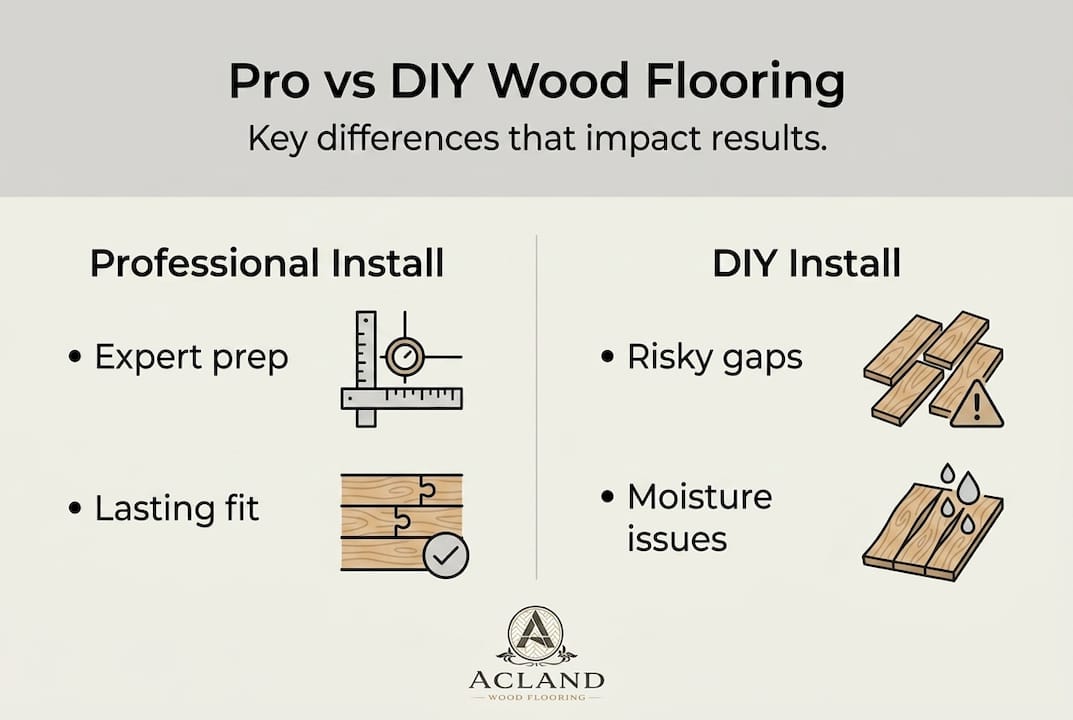
| Factor | Professional installation | DIY installation |
|---|---|---|
| Time investment | Efficient, planned timeline | Often underestimated |
| Skill level | Trained, experienced | Variable |
| Outcome quality | Consistent, high-quality | Inconsistent |
| Warranty support | Fully documented | Often voided |
For Glasgow homes, choosing flooring for humid climates also matters, and professionals know which products perform best locally.
Added value: Documentation, warranties and legal protection
Expert process is one side of the story. Now, let’s see how documentation rounds out the value of professional installation.
Most homeowners don’t realise that a manufacturer’s warranty can be voided entirely by poor installation. Professionals keep thorough records throughout the job, and that paperwork is what protects you if something goes wrong later. Installation documentation provides proof required for warranty claims and protects against disputes with suppliers or insurers.
The documentation a professional provides typically includes:
- Pre-installation moisture readings with dated records
- Subfloor condition checklist with photographic evidence
- Product batch numbers and installation method notes
- Post-installation inspection report
| Scenario | Professional install | DIY or unqualified install |
|---|---|---|
| Warranty claim accepted | Very likely | Unlikely or denied |
| Dispute resolution | Supported by records | Difficult without proof |
| Legal compliance (rental) | Met | Potentially at risk |
| Resale documentation | Available | Rarely available |
For property developers and landlords, this isn’t a nice-to-have. It’s essential. Proving that a floor was installed to a professional standard can resolve tenant disputes quickly and support building compliance requirements. Engineered wood flooring in particular comes with specific installation requirements, and documentation proves those requirements were followed.
Practical benefits: Aesthetics, longevity and market value
With warranties and paperwork sorted, let’s see how expert installation pays off in daily enjoyment and property investment.
A professionally installed floor simply looks better. There are no lippage issues between boards, no visible gaps forming after a few months, and no awkward transitions between rooms. The visual lines are clean and continuous, which matters enormously in open-plan Glasgow homes and commercial spaces where the floor is the dominant design feature.
Key visible advantages of professional craftsmanship include:
- Seamless board transitions across doorways and room changes
- Consistent gap sizing for a polished, intentional finish
- Correct direction of run to maximise the sense of space
- Precision around awkward features like hearths, bay windows, and curved walls
Beyond appearance, fewer gaps and defects mean easier cleaning and reduced moisture ingress over time. A board that sits tight to its neighbours is far less likely to trap dirt, lift at the edges, or allow water penetration. Proper installation delivers lasting aesthetics, easier maintenance, and improved property market value.

Pro Tip: Always ask your installer for documented proof of preparation work. Buyers and letting agents in Glasgow increasingly request this, and having it ready can directly improve your sale price or rental yield.
For inspiration on making the most of your floor’s visual impact, exploring design ideas for wood flooring or considering wide plank flooring can open up some genuinely striking possibilities.
Why professional flooring is worth it in Glasgow: Hard truths and overlooked wins
Here’s what most flooring guides won’t tell you. Glasgow’s housing stock is genuinely unusual. You have pre-war tenements with suspended timber subfloors sitting next to new-build developments with concrete slabs. Each requires a completely different installation approach, and the gap in expertise between a generalist tradesperson and a specialist flooring installer is significant.
DIY installs often feel like a success for the first six months. Then the squeaks begin. Then a gap appears. Then you discover the warranty is void. The hidden costs of avoiding common errors at the start almost always outweigh the upfront saving.
As we often say: ‘The best floors are invisible. They don’t squeak or gap. That’s the real win.’
Pro Tip: Insist on a written guarantee covering every component of the installation process, not just the product. This is how you protect your investment and hold your installer to account.
For those managing projects at scale, applying sound project management principles to flooring installations can help keep timelines and costs under control.
Enhance your space with expert wood flooring in Glasgow
If this guide has made one thing clear, it’s that the floor you enjoy every day is only as good as the installation behind it. At Acland Wood Flooring, we specialise solely in wood floors, which means every job we take on gets the full depth of our expertise.

Whether you’re working with Glasgow’s humidity and older properties or specifying floors for a new development, we tailor our approach to your specific conditions. From flooring suited to Glasgow’s climate to striking wood floor design ideas and premium engineered wood flooring, we’re ready to help you get it right from the start. Get in touch to request a quote or discuss your project with our team.
Frequently asked questions
Why is professional installation important for wood flooring?
It ensures the floor lasts longer, looks better, and avoids problems like gaps, squeaks, or moisture damage. With 80% of issues rooted in moisture mismanagement, professional prep is non-negotiable.
How does professional installation help with warranties?
Professionals document each stage, which provides the proof required for most manufacturer warranties. Proper preparation also reduces product failures by 70 to 80% compared to unqualified approaches.
What are the main mistakes people make in DIY floor installations?
Common mistakes include skipping moisture testing, improper acclimation, and not levelling the subfloor. These errors account for the majority of floor failures in service.
Can professional installation improve my property’s market value?
Yes, well-installed floors increase property appeal and reduce buyer concerns about future repairs. Lasting aesthetics and easier maintenance both contribute directly to stronger resale and rental outcomes.