
Wood floors are not all equal when it comes to warmth and energy efficiency. Understanding the thermal properties of wood floors matters enormously if you are specifying a floor for a new build, retrofitting an older home, or simply trying to keep heating bills down through winter. Yet the topic is riddled with assumptions: that all wood feels warm underfoot, that thicker always means better insulation, or that any wood floor will work with underfloor heating. This guide cuts through those assumptions with real data, practical comparisons, and specific advice for homeowners, builders, and architects.
Key takeaways
| Point | Details |
|---|---|
| Wood is a moderate insulator | Wood’s thermal conductivity sits between 0.10 and 0.20 W/m·K, far below metals but not as insulating as purpose-built materials. |
| Thickness and species both matter | Thicker boards and lower-density species produce higher R-values, directly improving wood flooring thermal insulation. |
| Moisture is the hidden enemy | Water filling wood’s air pockets can cut insulating ability by more than half, making humidity control non-negotiable. |
| Engineered wood suits radiant heating best | Its cross-ply construction offers dimensional stability under thermal cycling where solid wood can cup or gap. |
| Installation quality affects thermal performance | Poor acclimatisation, incorrect layering, and inadequate subfloor preparation all undermine the heat retention benefits of wood floors. |
Thermal properties of wood floors: the fundamentals
To evaluate any floor covering properly, you need two core measurements: thermal conductivity (the k-value) and thermal resistance (the R-value). Thermal conductivity tells you how readily a material transfers heat. Thermal resistance tells you how well it resists that transfer. The relationship is straightforward: R = thickness divided by k. So a thicker board or a species with a lower k-value will produce a higher R-value and better insulate the space below.
Wood’s thermal conductivity typically sits between 0.10 and 0.20 W/m·K, depending on species and density. Compare that to steel at around 50 W/m·K, and wood looks like a strong insulator. Against dedicated insulation boards, however, wood is a moderate performer at best. What makes it genuinely useful in buildings is the combination of moderate insulation, thermal mass, and the simple fact that it does not feel cold underfoot the way ceramic tile does.
Density plays a meaningful role here. Denser hardwoods like oak conduct heat more readily than lighter softwoods like pine. Grain direction also matters: heat flows more easily along the grain than across it, which has practical implications for plank orientation relative to your heating source. Thermophysical parameters including specific heat capacity and density are all needed for accurate building-energy modelling, and assuming a single generic value for all wood flooring leads to significant errors in those calculations.
Key factors that influence the R-value of a wood floor:
- Species: Lower-density softwoods insulate better than dense hardwoods
- Thickness: Every extra millimetre raises the R-value proportionally
- Grain direction: Cross-grain heat transfer is slower than along-grain
- Construction type: Solid, engineered, and parquet all differ in layering and therefore in thermal behaviour
- Subfloor and underlayment: These contribute meaningfully to the total thermal resistance of the floor assembly
Pro Tip: When specifying floors for energy-efficient buildings, always calculate the total floor assembly R-value rather than just the board alone. Underlayment, adhesive, and subfloor materials all stack up.
How moisture affects insulating performance
This is where many homeowners are caught off guard. Wood’s insulating ability comes from its air-filled cellular structure. Those tiny air pockets trap heat and slow conduction. When moisture enters the wood, it fills those pockets, and the insulating effect collapses. Moisture can cut insulating performance by more than 50%, turning what appeared to be a thermally efficient floor into a liability.

Seasonal humidity changes compound the problem. Wood floors expand and contract primarily perpendicular to the grain as moisture content shifts. The recommended indoor humidity range for dimensional stability and thermal performance is 35 to 55%. Below that range, floors dry out, gap, and potentially crack. Above it, they swell, cup, and lose insulating efficiency. Scotland’s climate makes this genuinely relevant, with damp winters and central heating creating wide seasonal swings in indoor humidity.
Maintaining consistent humidity does more than protect the floor aesthetically. It preserves the air pocket structure that provides heat retention in wood floors and keeps the floor performing as specified. For flooring in humid rooms such as kitchens and bathrooms, choosing species and construction types suited to moisture exposure is not optional. The best wood flooring for humid climates in Glasgow involves engineered construction with stable core materials rather than solid planks that move significantly with moisture.
Pro Tip: Fit a calibrated hygrometer in rooms with wood floors and aim to keep relative humidity between 40% and 50% year-round. A small investment in humidity control pays back far more than remedial floor repairs.
Wood floors and radiant heating systems
Underfloor heating and wood floors are entirely compatible when you understand the constraints. The main risk is localised overheating, which dries the wood unevenly and causes cupping, gapping, or cracking. Hydronic radiant systems typically operate at water temperatures of 85 to 105°F, producing floor surface temperatures between 68 and 80°F. The recommended maximum floor surface temperature for wood is around 80 to 82°F, which is 27°C. Staying below that threshold is the single most important rule.
Engineered wood, with its cross-ply core construction, handles the thermal cycling of radiant heating far better than solid wood. The layers are oriented in opposing grain directions, which significantly reduces expansion and contraction. Solid wood can work but requires thinner boards, narrower planks, and extremely careful acclimatisation. Review the engineered wood flooring benefits in detail before specifying a floor over any heated subfloor system.
Key installation requirements for wood over radiant heating:
- Board thickness: Keep total floor thickness at or below 18 mm to allow adequate heat transfer
- Plank width: Narrower planks move less with temperature changes; widths under 150 mm are generally safer
- Acclimatisation: Allow boards to acclimatise to the room conditions for at least 72 hours before fitting
- Sensor controls: Install floor temperature sensors and set maximum temperature limits at the thermostat
- Humidity monitoring: Maintain 35 to 55% relative humidity throughout the heating season
- Gradual commissioning: Raise system temperature slowly over several days after installation, never in one step
Maintaining floor surface temperatures below 27°C whilst controlling indoor humidity is what separates a successful radiant wood floor installation from a problematic one.
Comparing thermal performance across wood floor types
Not all products perform the same, and the differences are significant enough to influence your specification decisions. Thermal resistance varies substantially with thickness and construction type.
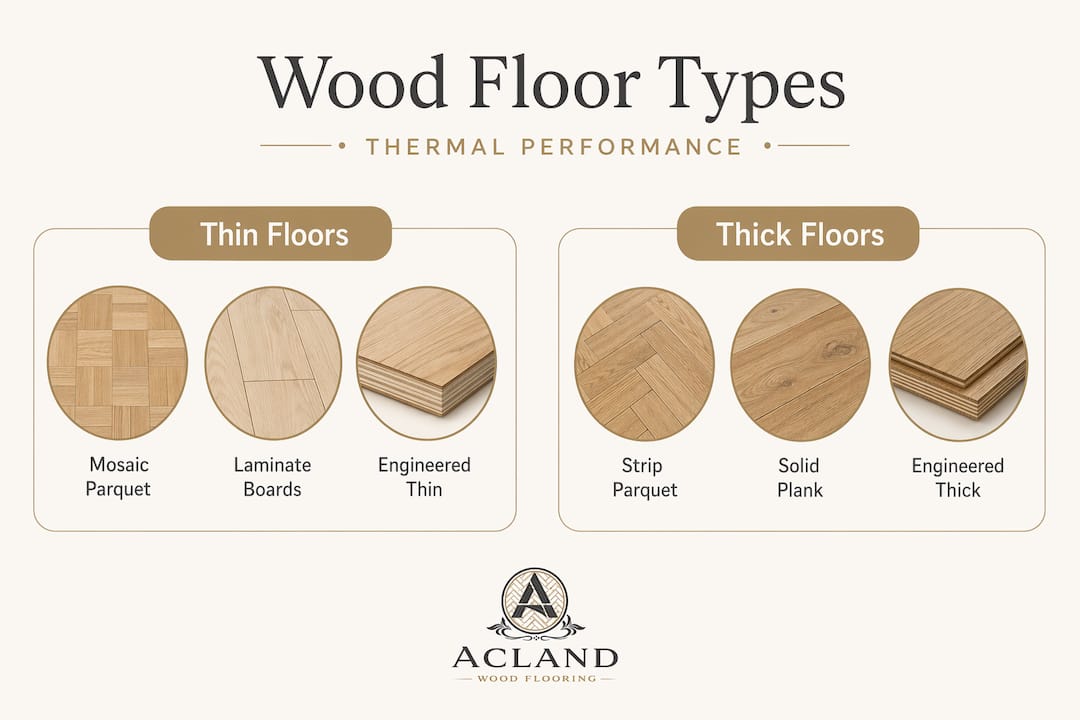
| Floor type | Thickness | Thermal conductivity (W/m·K) | Thermal resistance (m²·K/W) |
|---|---|---|---|
| Mosaic parquet (oak) | 8 mm | ~0.21 | ~0.038 |
| Strip parquet (oak) | 16 mm | ~0.21 | ~0.08 |
| Laminate | 9 mm | ~0.18 | ~0.05 |
| Engineered oak (15 mm) | 15 mm | ~0.19 | ~0.079 |
| Solid softwood (20 mm) | 20 mm | ~0.14 | ~0.14 |
The thermal resistance of a 16 mm strip parquet is roughly double that of an 8 mm mosaic tile, which illustrates precisely why thickness matters so much. Solid softwood at 20 mm outperforms them all on insulation because lower density means more air space within the cellular structure.
For radiant heating, thinner and denser floors dissipate heat upward more readily, which is actually what you want. For rooms without underfloor heating, thicker and less dense floors retain warmth more effectively. The energy efficiency of wood floors is never just a product of the board itself. It reflects the interplay between material properties and the broader building system including subfloor insulation, airtightness, and room orientation. Explore wood floor species differences to see how species choice translates into measurable thermal performance differences.
Practical guidance for selection and maintenance
When you translate thermal science into a purchasing decision, a handful of factors genuinely move the needle:
- Prioritise species and thickness together: A thick, low-density softwood floor delivers noticeably better insulation than a thin, dense hardwood.
- Match construction to application: Engineered wood for radiant heating or moisture-prone areas; solid wood where conditions are stable.
- Do not ignore the underlayment: The right underlayment adds meaningful R-value to the full assembly and can correct for minor subfloor irregularities.
- Avoid oversanding: Reducing board thickness through repeated sanding progressively lowers the R-value and shortens floor life.
- Commission heating systems correctly: Gradual temperature ramp-up after installation prevents premature stress on new boards.
Pro Tip: Floating installations add a small air gap and underlayment layer that often improves overall thermal resistance compared to glued-down methods. Review floating wood floor installation for guidance on when this approach suits your project.
My perspective on wood floors and thermal performance
I’ve worked with wood floors long enough to know that most conversations about warmth and insulation stay on the surface. Clients ask whether wood is warm. The honest answer is: it depends on what you mean and what you do with it.
What I’ve found is that the biggest thermal errors happen before the floor goes down. Skipping proper acclimatisation, choosing a floor purely on aesthetics without considering the heating system, or fitting a 20 mm solid board over hydronic heating because it looks beautiful. These are decisions that cause problems six months later. I’ve also noticed that engineered wood often outperforms solid wood in real-world thermal applications not because it insulates better in theory, but because it stays flat, stays tight, and maintains the floor assembly’s integrity over years of thermal cycling.
The other thing I’d push back on is treating the floor in isolation. Thermal performance is a product of the whole building envelope. A perfectly specified wood floor in a poorly insulated building with draughty windows will never perform as intended. Wood contributes. It does not compensate.
— John
Find the right floor for your building

At Aclandwoodflooring, we work with homeowners, builders, and architects across Glasgow who want floors that look exceptional and perform well thermally. Whether you are specifying engineered boards over a hydronic system or selecting a solid species for a period property, the choice of construction, thickness, and installation method all affect how your floor performs over time. Our wood floor layering guide covers how different construction approaches affect heat distribution and insulation. For species-by-species comparisons with thermal data, our species overview for Glasgow homeowners is the right starting point. Get in touch with us directly for tailored advice on your project.
FAQ
What is the R-value of a typical wood floor?
Thermal resistance varies with thickness and species. An 8 mm oak mosaic parquet delivers around 0.038 m²·K/W, whilst a 16 mm strip parquet of the same wood offers approximately 0.08 m²·K/W. Thicker, lower-density boards consistently perform better.
Is wood flooring a good insulator compared to other materials?
Wood is a moderate thermal insulator, with conductivity between 0.10 and 0.20 W/m·K. It significantly outperforms tiles and concrete underfoot, though it does not match purpose-built insulation materials on raw R-value.
Which wood floors work best with underfloor heating?
Engineered wood with a cross-ply core is the most suitable choice for radiant heating. It handles thermal cycling without warping and can be specified at thicknesses that allow efficient heat transfer whilst staying within the recommended 27°C surface temperature limit.
How does moisture affect the thermal properties of wood flooring?
Moisture replaces the insulating air pockets within wood’s cellular structure, potentially reducing insulating performance by over 50%. Keeping indoor humidity between 35% and 55% is the most effective way to preserve both thermal performance and dimensional stability.
Does a thicker wood floor always mean better insulation?
Thickness improves R-value directly, but species and density also matter. A thick dense hardwood may still insulate less effectively than a thinner softwood board. For underfloor heating applications, thinner floors are actually preferable as they allow heat to dissipate upward more efficiently.