
Flooring is one of the most expensive decisions you will make in any property, yet most people focus almost entirely on colour and style. The practical question of why choose durable flooring often gets pushed aside until problems appear: boards cupping in winter, tiles cracking under foot traffic, or a beautiful floor that looks tired within three years. In Scottish homes and commercial properties, where damp conditions and cold winters are routine, flooring durability is not a luxury consideration. It is what separates a floor that lasts decades from one that needs replacing far too soon.
Key takeaways
| Point | Details |
|---|---|
| Durability depends on more than material | Installation quality and indoor humidity management influence longevity more than brand or product alone. |
| Scottish climate demands moisture resistance | Choose materials rated for moisture exposure, particularly in kitchens, hallways, and ground-floor rooms. |
| Safety compliance is non-negotiable | Commercial and rental properties must meet UK slip resistance standards to avoid legal liability. |
| Acclimatisation prevents early failure | Wood floors need 3 to 5 days to acclimatise before fitting to prevent cupping and gapping. |
| Maintenance sustains durability ratings | Slip resistance and surface integrity can degrade without correct cleaning and upkeep over time. |
Why choose durable flooring: what it really means
Most people assume durable flooring simply means a hard floor. The reality is more specific, and understanding the difference will save you money and frustration.
When flooring professionals talk about durability, they are referring to a combination of properties working together:
- Wear resistance: How well the surface holds up against scratching, scuffing, and abrasion from foot traffic, furniture, and everyday use.
- Moisture and stain resistance: Critical for Scottish homes where wet boots, muddy dogs, and condensation are facts of life rather than occasional inconveniences.
- Impact resistance: The ability to absorb knocks without cracking or chipping, particularly relevant in kitchens and hallways.
- Dimensional stability: How well a floor holds its shape and size when temperature or humidity changes, which matters enormously in Scotland’s variable climate.
- Maintenance requirements: A floor that needs constant sealing, polishing, or refinishing is not truly low-maintenance, regardless of its hardness rating.
- Slip resistance: Floors that meet UK safety standards protect both residents and property managers from accidents and legal risk.
Pro Tip: When evaluating flooring, ask the supplier for the PEI rating (for tiles) or the AC rating (for laminates and LVP). These ratings tell you exactly what traffic levels a floor is designed to handle, rather than relying on vague marketing claims.
Comparing popular durable flooring materials
Understanding what to consider in flooring choices means looking honestly at the trade-offs each material presents. No single product is perfect for every situation.
| Material | Durability | Moisture resistance | Maintenance | Relative cost |
|---|---|---|---|---|
| Porcelain tile | Excellent | Excellent | Low | Medium to high |
| SPC / LVP | Very good | Excellent | Low | Low to medium |
| Engineered wood | Good | Moderate | Medium | Medium to high |
| Solid hardwood | Good | Poor | High | High |
| Concrete | Excellent | Good (sealed) | Low to medium | Variable |
| Rubber | Very good | Very good | Low | Medium |
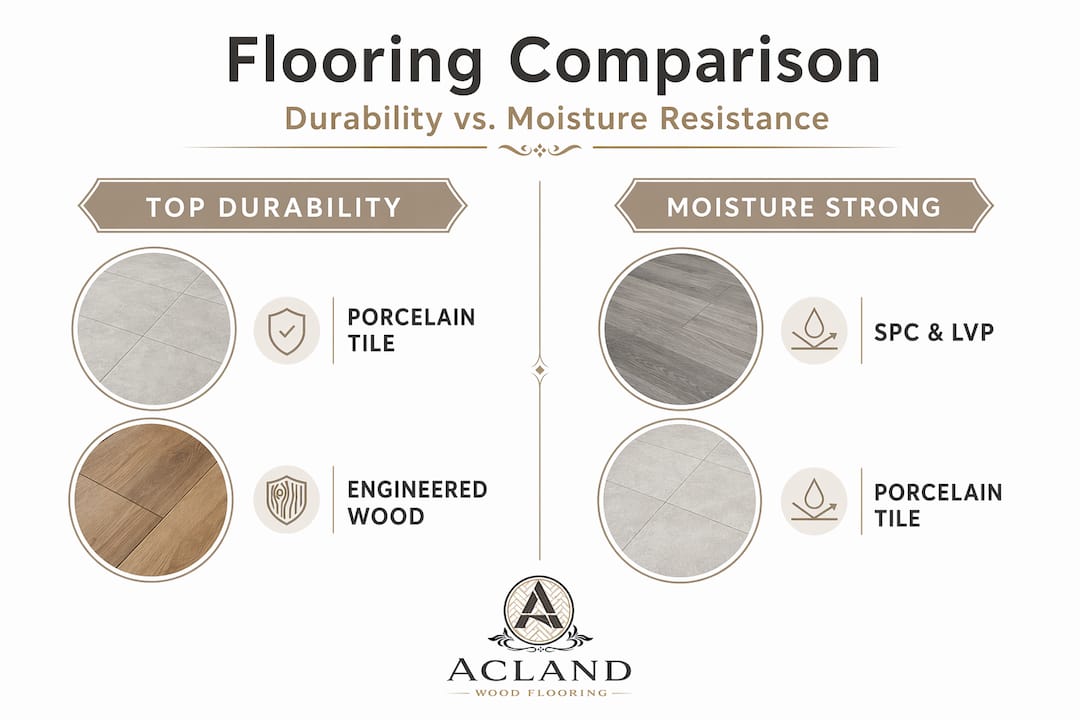
Porcelain tile is widely considered the most durable residential flooring available. Fired above 2200°F, it achieves water absorption below 0.5% and a PEI Class 5 rating suitable for heavy commercial traffic. It will not warp, swell, or stain easily. The drawback is that it is cold underfoot and unforgiving if you drop something fragile.
SPC (Stone Plastic Composite) and LVP (Luxury Vinyl Plank) have become the go-to recommendation for moisture-prone rooms. SPC is 100% waterproof with dimensional stability of 0.10% or less under standard temperature ranges, which makes it an excellent match for underfloor heating systems. It will not expand or contract significantly as your heating cycles on and off through a Scottish winter.
Engineered wood offers the warmth and authenticity that many homeowners want, and it handles humidity better than solid wood. That said, it still requires careful acclimatisation before fitting and ongoing humidity management, ideally keeping indoor relative humidity between 40% and 55%. For homes and commercial spaces in Scotland, this is a realistic but active commitment.
Solid hardwood is beautiful and can be sanded and refinished multiple times over its life, but it is sensitive to moisture and not suitable for ground-floor rooms with damp subfloors or wet underfloor heating systems. It suits period properties in controlled environments better than modern open-plan homes with variable humidity.
Pro Tip: If you are installing over underfloor heating, always confirm the floor’s thermal resistance rating before purchasing. Some materials trap heat and reduce system efficiency while also damaging themselves over time.
Installation and environment: why they matter more than you think
Here is the part that surprises most property owners: most flooring failures arise from poor installation or unmanaged building conditions, not from a defective product.
The key factors that determine whether your floor performs as promised are:
- Subfloor condition: A damp or uneven subfloor will cause almost any floor to fail prematurely. If you are installing over underfloor heating, screed quality directly affects both heat distribution and long-term floor stability. Poor screed leads to cracking, uneven heating, and early floor damage.
- Acclimatisation: Wood floors, including engineered options, must acclimatise for 3 to 5 days in the room where they will be fitted. Skipping this step in Scotland’s damp climate is one of the most common causes of cupping and gapping after installation.
- Expansion gaps: Every rigid floor material needs room to move slightly. Fitting boards too tightly against walls or door frames creates pressure that buckles the floor within months.
- Humidity management: Scotland’s climate means indoor humidity can shift significantly between summer and winter. Wood floors in particular need consistent indoor conditions to remain stable.
- Traffic and use patterns: High-traffic areas like hallways and commercial receptions need a floor specified for that level of use, not simply the most attractive option in the showroom.
If you want to understand how these factors play out in practice, the wood floor installation guide from Aclandwoodflooring covers subfloor preparation and fitting best practices in detail.
Safety and compliance for UK properties
For property managers, the advantages of sturdy flooring go beyond aesthetics and longevity. Flooring that does not meet UK slip resistance standards creates genuine legal exposure.
UK health and safety regulations require that commercial floors achieve a minimum PTV score of 36+ in wet conditions to be considered acceptably safe. PTV stands for Pendulum Test Value, and it is the standard used by UK enforcement authorities. R-ratings, which you may see on product packaging, relate to oil-contaminated ramp testing used in industrial environments and are not directly comparable.
Property managers should prioritise slip resistance compliance over aesthetics. Fitting a floor that fails to meet PTV 36+ in a commercial or rental property is not just a safety risk; it is an insurance and liability risk that could prove costly if an accident occurs.
What makes this more complicated is that slip resistance can degrade over time through wear, cleaning methods, and surface contamination. A floor rated appropriately on installation may fall below the recommended threshold within six months without correct maintenance. Specifying the right floor is only the beginning. Maintaining it correctly is what keeps you legally protected.
My honest take on durable flooring decisions
I have spent years advising homeowners and property managers across Scotland, and one thing I know to be true is that people consistently overestimate the role of the product and underestimate the role of the environment.
I have seen expensive imported hardwood floors fail within a year in properties with damp ground floors and no humidity control. I have also seen well-chosen engineered boards from a mid-range range perform beautifully for fifteen years because the installation was done properly and the building was managed well. The product matters. But it is rarely the deciding factor.
What I tell every client is this: the benefits of durable flooring are only realised when the right material is matched to the right environment, installed correctly, and maintained consistently. Choosing the most durable product on the market and fitting it without proper subfloor preparation is like buying a high-quality tyre and fitting it to a buckled wheel. You will not get the performance you paid for.
My advice to Scottish homeowners and property managers is to treat flooring as a system, not a product. Get the subfloor right. Manage indoor humidity. Choose materials that match your traffic levels and moisture exposure. Then, and only then, focus on aesthetics.
— John
How Aclandwoodflooring can help you choose right
Choosing between materials, installation methods, and safety requirements is a lot to navigate without experienced guidance. Aclandwoodflooring works exclusively with wood and wood-style flooring, which means the advice you receive is focused and specific to your property’s needs rather than driven by broad stock ranges.

Whether you are considering engineered wood flooring for a residential renovation or need professional fitting that accounts for underfloor heating and Scottish humidity, Aclandwoodflooring offers both the materials and the installation expertise to get it right first time. You can also explore wood floor styles suited to modern Scottish homes, covering everything from herringbone patterns to wide-plank designs. Contact the team directly for tailored advice on your specific space and requirements.
FAQ
What makes flooring truly durable?
Durability in flooring comes from a combination of material hardness, moisture resistance, dimensional stability, and correct installation. A floor can only perform to its rated specification if the subfloor is properly prepared and indoor conditions are managed.
Which materials are best for durable floors in Scotland?
Porcelain tile and SPC flooring offer the strongest moisture resistance and durability for Scottish conditions. Engineered wood is a good option where natural warmth is a priority, provided humidity is managed and acclimatisation is completed before fitting.
Do durable floors still need maintenance?
Yes. Even the toughest flooring materials require appropriate cleaning and upkeep to maintain their performance ratings. Slip resistance, for example, can degrade within months if incorrect cleaning products or methods are used.
What slip resistance standard applies to UK commercial floors?
UK regulations recommend a minimum Pendulum Test Value of 36 for wet commercial and public areas. This is the relevant standard for property managers in Scotland and applies regardless of the material specified.
How long does acclimatisation take for wood flooring?
Wood floors, including engineered boards, typically require 3 to 5 days of acclimatisation in the installation room before fitting. Skipping this step is one of the most common causes of cupping and gapping, particularly in Scotland’s variable climate.