
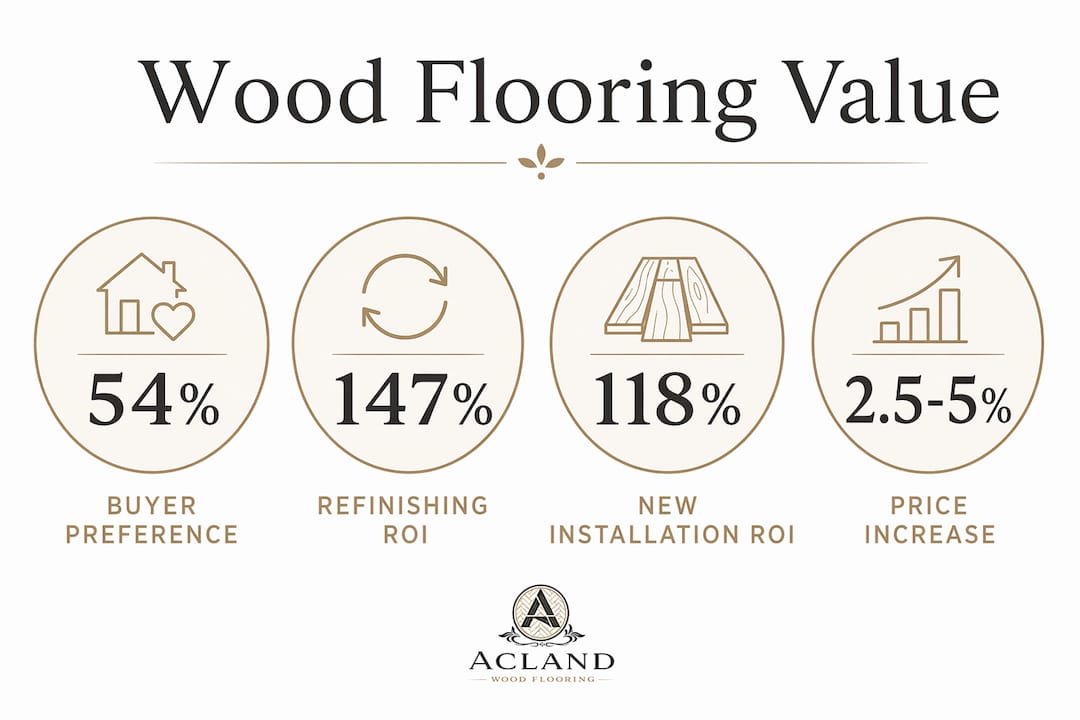
Wood flooring is one of the highest-return interior upgrades a Scottish homeowner or investor can make, with 54% of buyers willing to pay more for a home that has it. The impact of wood flooring on property value is measurable and consistent: homes with hardwood floors sell for 2.5 to 5% more than comparable properties without them. For Scottish buyers and sellers, the calculation also involves local appraisal practice, moisture management, and the particular character of the country’s older housing stock. Get these factors right, and wood flooring becomes one of the most reliable tools in a property investor’s kit.
What does the evidence say about wood flooring and property value?
The data on property value hardwood flooring is clear and consistent. The National Association of Realtors 2022 Remodelling Impact Report, widely cited across the industry, shows that new hardwood installation delivers approximately 118% return on investment at resale. Refinishing existing boards returns an even stronger 147%. These figures confirm that flooring can outperform kitchens and bathrooms as a renovation category when executed well.
Buyer behaviour reinforces the numbers. Research summarised by OpenDoor shows buyers pay roughly £5,000 more for homes with refinished wood floors and around £6,500 more for new installations. That premium reflects not just aesthetics but the signal wood floors send: the property has been maintained, the materials are durable, and the owner cared about quality.
The table below summarises the key financial benchmarks for Scottish homeowners weighing their options.
| Option | Typical cost per sq ft | Estimated ROI | Buyer premium |
|---|---|---|---|
| New hardwood installation | £8 to £15 | 118% | Approx. £6,500 |
| Refinishing existing boards | £3 to £5 | 147% | Approx. £5,000 |
| Engineered wood (new) | £6 to £12 | 100 to 115% | Comparable to hardwood |
The refinishing figures are particularly relevant in Scotland, where Victorian and Edwardian terraces often conceal original pine or oak boards beneath decades of carpet. Restoring those boards costs a fraction of replacement and frequently yields a stronger return.
How do Scottish property appraisers evaluate wood flooring?
Wood flooring property appraisal in Scotland follows the same core logic as elsewhere in the UK: flooring is treated as a permanent improvement that affects a property’s condition rating, effective age, and comparability with similar homes on the market. Cohesive wood flooring consistently scores better in appraisals than mismatched or poor-quality alternatives.
Appraisers assess several specific factors when they walk through a property:
- Condition and continuity. Floors that run consistently through open-plan spaces read as higher quality than rooms with different flooring types meeting awkwardly at thresholds.
- Installation quality. Poorly fitted boards, visible gaps, or uneven surfaces signal deferred maintenance and reduce condition scores.
- Material authenticity. Solid hardwood and quality engineered wood are treated more favourably than laminate or vinyl, which appraisers recognise as lower-cost substitutes.
- Moisture damage. Cupping, warping, or staining from damp immediately flags a maintenance problem and can reduce a property’s effective age rating.
The distinction between solid hardwood and engineered wood flooring matters in appraisal terms. Engineered boards perform well in Scottish conditions and are appraised similarly to solid wood when the quality is high and the installation is professional. The key variable is always finish and fit, not just material.
Pro Tip: Before listing a property, have a flooring professional assess your boards for surface wear and structural integrity. A professional sand and refinish costs far less than a price reduction negotiated by a buyer who notices the floors.
Refinishing versus new installation: which offers better value in Scotland?
The financial case for refinishing existing wood floors is strong. Refinishing typically costs £3 to £5 per square foot, compared to £8 to £15 per square foot for a full new installation. The 147% ROI on refinishing versus 118% for new boards means that restoring what you already have is almost always the smarter financial move, provided the existing floors are structurally sound.
The decision tree is straightforward. Refinishing is the right choice when boards are solid, at least 18mm thick (to allow sanding), and free from significant moisture damage or structural failure. Replacement becomes necessary when boards are too thin to sand again, have been damaged by water ingress, or were never a quality material worth preserving.
For Scottish properties, the refinishing versus replacement decision has an additional layer. Many older homes in Glasgow, Edinburgh, and Aberdeen have original timber floors that are genuinely valuable. Replacing them with new boards, even high-quality ones, can actually reduce a property’s character and appeal to buyers who specifically seek period features. Preserving original boards through professional refinishing often adds more value than a modern replacement would.
Pro Tip: Commission a damp survey before committing to any wood flooring investment. Moisture problems discovered after installation are far more expensive to resolve than those caught beforehand.
How does Scotland’s climate affect wood flooring’s value impact?
Scotland’s humidity levels create specific risks for timber floors that directly affect their long-term contribution to property value. Maintaining moisture content below 20% in wood prevents fungal decay and the structural failure that follows. Properties where this threshold is exceeded face cupping, warping, and eventual board failure, all of which destroy the value that wood flooring is supposed to create.
For historic and listed buildings, the considerations go further. Scotland has a significant stock of listed properties, and any flooring work in these buildings must follow conservation principles aligned with BS 7913:2013. The key requirements are:
- Minimal intervention. Treat and restore rather than replace wherever possible.
- Reversibility. Use finishes and adhesives that can be removed without damaging the original fabric.
- Compatibility. New materials must be compatible with existing historic finishes and substrates.
- Consent. Listed building consent is required for any work that materially alters the character of a floor, including replacement and in some cases refinishing.
Choosing the right species and installation method for Scotland’s climate is also a practical value decision. Engineered wood handles humidity fluctuation better than solid hardwood in many Scottish homes, particularly those without underfloor heating or consistent temperature control. Aclandwoodflooring’s guide to flooring in humid climates covers species and construction choices suited to Glasgow and the surrounding area.
What buyer preferences in Scotland shape the value of wood floors?
Mintel’s 2026 UK consumer trends show that buyers are focused on price and quality, prioritising improvements that signal good maintenance and long-term value. Wood flooring fits this preference precisely. It reads as a quality material, it is durable, and it communicates that a property has been looked after.
Current buyer preferences in Scotland favour:
- Natural materials. Oak, ash, and walnut remain the most desirable species for buyers seeking warmth and authenticity.
- Herringbone and chevron patterns. These styles, particularly popular in period properties, command a premium in the Glasgow and Edinburgh markets.
- Consistent finishes. Matt and satin oil finishes are preferred over high-gloss lacquers, which can look dated and show wear more visibly.
- Engineered wood in flats. For tenement flats and modern apartments, engineered boards offer the look of hardwood with better acoustic and moisture performance.
Wood floors also accelerate sales. Homes with well-presented hardwood floors spend less time on the market because they photograph well, present strongly at viewings, and reduce the mental list of work buyers feel they need to do after purchase. That speed has a real financial value for investors managing holding costs.
Key takeaways
Wood flooring increases property value most reliably when existing boards are restored rather than replaced, and when moisture risks are managed before any investment is made.
| Point | Details |
|---|---|
| Refinishing beats replacement on ROI | Refinishing returns 147% versus 118% for new installation, at a fraction of the cost. |
| Buyer premium is real and quantifiable | 54% of buyers pay more for wood floors, with premiums of up to £6,500 for new boards. |
| Appraisers reward cohesion and quality | Consistent, professionally installed floors improve condition ratings and comparability scores. |
| Moisture management is non-negotiable in Scotland | Keeping timber moisture content below 20% prevents decay that destroys flooring value. |
| Listed buildings require conservation compliance | BS 7913:2013 governs flooring work in historic Scottish properties, including consent requirements. |
Why I always start with the floors that are already there
I have seen homeowners spend £12,000 on new engineered boards when the original Victorian pine underneath was perfectly sound and would have cost £1,500 to restore. The new floor looked fine. The old one would have looked better, cost less, and told a more compelling story to buyers. That pattern repeats itself more often than it should.
My honest view is that the role of flooring in property value is consistently underestimated at the planning stage and overestimated at the point of sale. People assume a new floor always beats a restored one. The data says otherwise, and so does the reaction of buyers who walk into a room with original boards that have been properly sanded and oiled.
The other thing I would stress for Scottish properties specifically is the moisture survey. I have seen beautiful new floors fail within two years because the subfloor was damp and nobody checked before installation. A survey costs a few hundred pounds. A failed floor costs thousands, and it costs you the sale price premium you were trying to create in the first place.
If you are preparing a property to sell or let, start with an honest assessment of what you already have. Restore where you can, replace only where you must, and always check the moisture before you commit. That sequence produces the best outcomes, financially and practically.
— John
How Aclandwoodflooring helps Scottish homeowners increase property value
If you are ready to act on the evidence, Aclandwoodflooring provides the specialist knowledge and installation quality that makes the difference between a floor that adds value and one that merely covers the subfloor.

The team at Aclandwoodflooring works exclusively with wood floors, which means every recommendation is grounded in direct experience with Scotland’s housing stock, climate, and buyer expectations. Whether you are considering solid wood flooring for a family home in Glasgow or need expert advice on restoring period boards in an older property, Aclandwoodflooring offers honest assessments and professional results. Explore the full range of services and find out how the right floor, properly installed, can boost your property’s value before your next sale or letting.
FAQ
Does wood flooring increase property value in Scotland?
Yes. Homes with hardwood floors sell for 2.5 to 5% more than comparable properties without them, and 54% of buyers say they would pay a premium for wood floors.
Is refinishing better than replacing wood floors for ROI?
Refinishing returns approximately 147% at resale versus 118% for new installation, making it the stronger financial choice when existing boards are structurally sound.
How do appraisers treat wood flooring in Scotland?
Flooring is assessed as a permanent improvement affecting condition rating and comparability. Cohesive, professionally installed wood floors consistently produce better appraisal outcomes than mismatched or low-quality alternatives.
Do I need consent to refinish floors in a listed Scottish building?
Listed building consent may be required for flooring work that materially alters the character of the property. Work must follow BS 7913:2013 conservation principles, prioritising reversibility and minimal intervention.
Why is moisture management important before installing wood floors in Scotland?
Scotland’s humidity levels mean timber moisture content can exceed 20%, the threshold at which fungal decay begins. A damp survey before installation prevents costly failures and protects the value the floor is intended to create.